
Exoteric and Esoteric Complexity: The Civilizational Choice Between the Maze and the Cathedral
Esoteric depth or exoteric sprawl: Choosing between the Builder and the Negotiator paths.
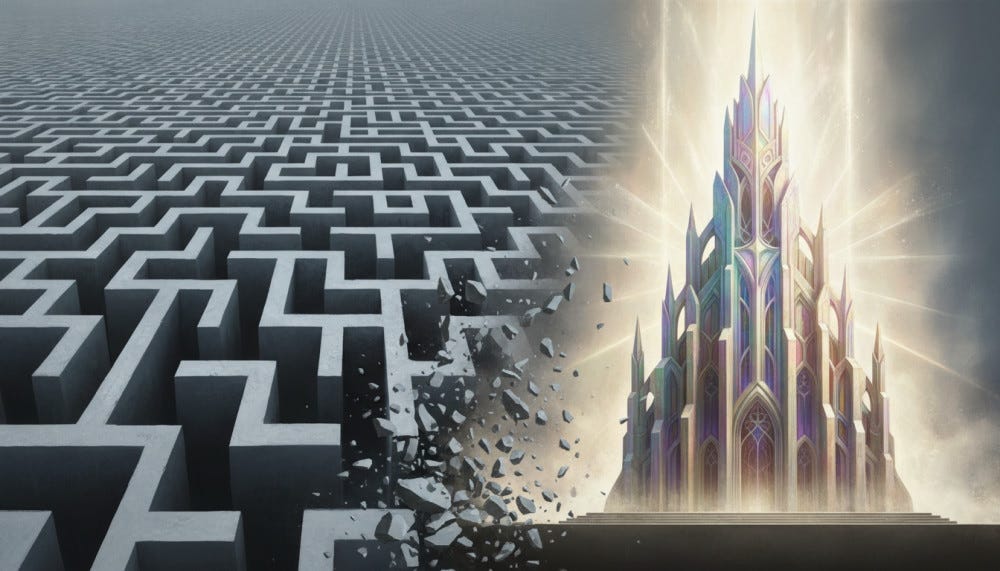
Complexity is not a singular phenomenon, and the failure to distinguish between its two fundamental expressions has produced some of the gravest errors of our civilization. There is a complexity that moves downward and inward—the complexity of depth, integration, and character—and there is a complexity that moves outward and across—the complexity of regulation, dependency, and sprawl. These two complexities are not merely different in degree but opposed in kind. One is generative; the other is parasitic. One produces sovereignty; the other produces servitude. And the choice between them is not a matter of preference but of ontology: it is the same choice, expressed at the level of social architecture, between the Logos and the anti-Logos, between the Master Builder and the Master Negotiator, between the Creator and the Victim.
Esoteric complexity is vertical. It is the complexity of the well rather than the web. A person who has spent decades integrating the laws of identity, non-contradiction, and causality into the marrow of his being possesses a depth that cannot be transferred through a checklist, a regulation, or a procedural manual. This complexity has distinctive hallmarks: integration over accumulation, compression rather than expansion, causal fluency across long stretches of time, and—most importantly—it is earned rather than granted. No institution can confer it. It is the fruit of disciplined inquiry, sustained perseverance, and the willingness to face uncomfortable truths about oneself. It is the complexity of the Master Builder, whose power flows from his alignment with the unmoved mover and whose structures stand because they are built on the foundation of first principles.
Exoteric complexity, by contrast, is horizontal sprawl. It is the complexity of the regulatory code, the global supply chain, the bureaucratic flowchart, the proliferating compliance manual. It is additive rather than integrative—each new rule, each new dependency, each new node added to the system without any corresponding deepening of understanding in the human beings who interact with it. Its hallmarks invert those of esoteric depth: accumulation without coherence, brittleness disguised as robustness, dependency in place of sovereignty, and overwhelm deployed as a structural feature rather than acknowledged as a structural failure. The U.S. Code of Federal Regulations exceeds 180,000 pages. No human mind has integrated it; no human mind can. This is the domain of the Master Negotiator, who thrives precisely because the system has been engineered to reward leverage over coherence.
In my previous article, I articulated the foundational distinction between the TED Triangle and the Drama Triangle as opposing ontologies—two systems organized around incompatible centers of gravity. The Creator declares “I can” and from that generative principle, the Challenger and Coach roles arise as natural extensions of engaged participation with reality. The Victim declares “I can’t” and from that helpless principle, the Rescuer and Persecutor roles arise as natural extensions of weakness weaponized against reality. The two systems cannot be balanced or compromised between because they are not ethical preferences but opposing relationships with truth itself. This same structural dichotomy plays out at the level of civilizational architecture. The Master Builder is a powerful Creator—his “I can” produces structures that radiate outward from coherent first principles. The Master Negotiator is a powerful Victim—his entire operation depends on the diffusion of responsibility, the cultivation of leverage, and the manipulation of systems that have no internal coherence of their own.
The task before us collectively is a Herculean one. That of developing critical societies. The idea of a critical society dates back many hundred years, but it was very pointedly called for in 1906, by William Graham Sumner, the great anthropologist, who emphasized in his seminal book, “Folkways,” that if a critical society existed – that is, a society in which critical thinking was a major social value – if such a society were to emerge, it would transform every dimension of life and practice. We are far from such a society, but we need to think about it. It needs to be part of our vision.
~Dr Richard Paul, The Foundation for Critical Thinking
This is why exoteric complexity is not merely a different organizational style but the architectural signature of the anti-Logos. A society organized around esoteric depth requires few external rules because each citizen carries the internal orientation necessary for lawful conduct. The natural law suffices because each person has integrated it through the cultivation of character. A society organized around exoteric complexity, however, requires endless external scaffolding precisely because its citizens have not developed—or have been actively prevented from developing—the internal coherence that would make such scaffolding unnecessary. The proliferation of external complexity is always evidence of internal vacancy. The regulatory state’s 180,000 pages of code betray the absent ethic of the society it governs. The narcissist’s myriad of shifting personalities betray the absent self at his core. The empire’s expanding legal apparatus betrays its absent legitimacy.
Consider how the principle “ignorance of the law is no excuse” operates differently under each regime. Under natural law, the maxim is entirely just—to plead ignorance of the prohibition against murder is to plead ignorance of one’s own humanity. A man of developed character carries within himself sufficient orientation to remain lawful, and the law itself is knowable through the exercise of ordinary reason. But under exoteric complexity, the same maxim becomes monstrous. A citizen can be ruined for violating a regulation he could not possibly have known existed, that bears no relation to natural law, that may contradict other regulations, and that may be interpreted differently by different enforcement agents. The principle’s presupposition—that law is knowable through right reason—has collapsed, but the principle continues to operate as an instrument of arbitrary power rather than justice.
The true version of “ignorance is no excuse” applies not to citizens navigating an unknowable maze but to those who participate in harm—whether they consciously admit it or merely sense it beneath the surface of their compliance. Many agents would likely plead ignorance with genuine sincerity at the conscious level while their unconscious has already aligned with the system’s predatory logic, because that alignment serves their lusts, their greed, or their need for tribal belonging. They do not see, because they have arranged not to see. The man who signs knowing fraud is concealed cannot plead ignorance of the law’s first principle; nor can the official who senses, but refuses to examine, that the regulation he enforces produces harm. Causality does not recognize chain of command as a legitimate severing of responsibility, nor does it honor the convenient unconsciousness that lets a participant feel innocent while collecting the benefits of complicity. This is where the notice of liability becomes the proper instrument of Logocentric accountability: it formalizes the causal trail, names the individual actor, and converts unconscious participation into a conscious choice from which no further plausible denial can be constructed. The notice does not punish—it restores truth to its proper place, transforming the choice from “obey without knowledge” into “obey knowing the cost,” and stripping away the unconscious cover that made the harm feel impersonal.
Exoteric complexity creates the illusion of escape from karma by fragmenting responsibility so thoroughly that no single actor appears causally responsible for any particular outcome—and this fragmentation succeeds precisely because the participants unconsciously want it to succeed. The individual signs the document prepared by the lawyer, who relied on the accountant, who followed the regulation written by the agency, which was lobbied by the corporation. When harm results, each actor points to another link in the chain and claims he was merely executing his role. The maze works because it provides each participant exactly the moral cover his unexamined life requires. But karma—genuine causality as lived consequence—does not honor this fragmentation, nor does it grant exemption for unconsciousness that was itself a choice. The debt remains owed. The diffusion across nodes obscures who must eventually face the reckoning, but it does not eliminate the reckoning itself. The maze is not karma-proof; it is merely karma-delayed, and the accumulated weight grows heavier the longer the delay continues.
This is why the Master Negotiator dominates within exoteric complexity and the Master Builder is systematically disadvantaged. The Negotiator has no internal coherence to betray, so he has no vulnerabilities to exploit. He trades constantly, yields strategically, and advances through pure leverage. The Builder, whose power is bound to truth and possibility, refuses to make the concessions the system requires. He cannot sacrifice first principles for position, and the system has been engineered to reward precisely those who will. The result is a permanent inversion: those most equipped to govern—those of integrated character and coherent vision—are filtered out of positions of institutional authority, while those least equipped—the hollow operators whose only competence is the negotiation of fictions—rise to the top and shape the conditions everyone else must navigate.
The wealth requirement embedded in exoteric complexity is not accidental but structural. A man of developed character can navigate a simple, knowable system with minimal resources because his internal orientation suffices. But exoteric complexity demands external scaffolding, and external scaffolding is expensive. The plowman of antiquity needed no lawyer; the modern farmer needs teams of them. This creates a permanent economic advantage for those already wealthy enough to afford intermediaries, while locking the poor into dependency on state-provided proxies who lack the resources to mount genuine resistance. Complexity begets wealth concentration, which funds the maintenance of complexity, which deepens wealth concentration further. The system perpetuates itself by ensuring that no one without significant means can ever achieve sovereign participation within it.
The narcissist is the perfect microcosm of this entire architecture expressed at the level of the individual psyche. He has no continuous self at his core—only a catalog of personalities deployed instrumentally based on which one maximizes utility in the moment. His apparent complexity is dazzling and wide, but catastrophically brittle. A single sustained challenge from someone anchored in their own esoteric depth can cause the entire performance to collapse, because no node of his personality can stand alone. He requires an army of self-abandoners around him to function—external mirrors that reflect back the image he needs to see, because he has no internal mirror of his own. Scale this dynamic to the institution, and you get the corporation whose hollow ethic requires elaborate compliance theater. Scale it to the civilization, and you get the global censorship apparatus erected to prevent anyone from noticing that the collective “I AM” was never earned, only declared.
The compliant mind that exoteric complexity requires is, structurally, a mind without essential questions—and this absence is not merely a cognitive habit but an unconsciously chosen defense. As Paul and Elder observe, “It is not possible to be a good thinker and a poor questioner.” The compliant citizen accepts the regulatory framework as a given and asks only “how do I satisfy this requirement?” rather than “is this requirement just?” He has ceded the generative power of inquiry and replaced it with the mechanical application of predetermined answers, because genuine inquiry would expose the alignment between his unexamined interests and the system’s predatory logic. His mind is not intellectually alive; it is operationally functional, and operational functionality is precisely what allows him to remain unconscious of his own complicity. Deductive rigidity becomes the cognitive style perfectly suited to compliance, while abductive fluidity—the willingness to test premises against observable reality—becomes structurally dangerous to systems built on unexamined assumptions and to the unexamined participants who depend on them. The cultivation of essential questions is therefore both the path to genuine understanding and an act of subtle resistance against the architecture of control—and against the unconscious within oneself that has been arranged to serve that architecture.
The remedy at every scale is the same: the patient cultivation of esoteric depth. The individual must earn his “I AM” (Logocentric identity) through the integration of the laws of identity, non-contradiction, and causality across time. The community must form around shared first principles deeply held rather than shared procedures superficially followed. The civilization must rediscover the natural law as the only legitimate foundation for positive law. This is not nostalgia for a simpler past—it is recognition that simplicity at the level of external arrangements is the consequence of depth at the level of internal character. The cathedral built outward from a single integrating principle does not need elaborate scaffolding to remain standing; its coherence is structural rather than imposed. The maze without a center, by contrast, requires ever more material to sustain itself and ever more victims to feed its hollowness.
The Master Builder operating from genuine Logocentric foundation does not need to negotiate with parasitic systems because his structures speak for themselves. When something coherent is constructed beside something hollow, the hollow thing collapses—not because the Builder pushed it, but because reality does not sustain fiction indefinitely. What appears to the parasitic class as brutality is merely the collision between their fiction and the immovable fact of how things actually are. Their experience of “harm” is indistinguishable from their karma materializing—the delayed consequences of their own causal choices, including the choice to remain unconscious of those choices, suddenly compressed into visible time. The Builder accrues no karma because he never intended damage; he intended only to build truly (based upon the Logos), and the collapse of false structures is their own doing, expressed through the medium of his superior coherence. What also collapses, alongside the institutional fiction, is the unconscious alignment that sustained it within each participant—the moment of recognition that one’s claimed innocence was never innocent. This is the real power asymmetry between Builder and Negotiator: the Negotiator must constantly manage the wills of others, while the Builder merely aligns with reality and allows reality to do the work.
The civilizational choice before us is therefore not a matter of policy preference or institutional reform within the existing framework. It is an ontological choice between two opposing relationships with reality itself, and it is simultaneously a psychological choice each person must make about what they have, until now, arranged not to see. We can continue building outward—more rules, more dependencies, more interfaces, more layers of compliance theater that conveniently preserve our unconscious innocence—and watch the maze grow heavier and more brittle until it collapses under its own incoherence, taking with it the comfortable unconsciousness of those who served it. Or we can return to the slower, harder, and infinitely more rewarding work of building downward, into the substance of the self, confronting what we have chosen to ignore, and then outward from that substance into structures that radiate coherence rather than demand it. The maze without a center is the signature of the anti-Logos and the natural habitat of the Master Negotiator and of every participant who declines to examine why the maze suited him. The cathedral built from a single integrating principle is the signature of the Logos and the natural creation of the Master Builder. There is no middle path between them—only the choice of which one you will spend your life constructing, and the prior choice of whether you will allow yourself to know what you are constructing while you build it.
Did you enjoy the article? Show your appreciation and buy me a coffee:
Bitcoin: bc1qmevs7evjxx2f3asapytt8jv8vt0et5q0tkct32
Doge: DBLkU7R4fd9VsMKimi7X8EtMnDJPUdnWrZ
XRP: r4pwVyTu2UwpcM7ZXavt98AgFXRLre52aj
POL: 0xEf62e7C4Eaf72504de70f28CDf43D1b382c8263F
THE UNITY PROCESS: I’ve created an integrative methodology called the Unity Process, which combines the philosophy of Natural Law, the Trivium Method, Socratic Questioning, Jungian shadow work, and Meridian Tapping—into an easy to use system that allows people to process their emotional upsets, work through trauma, correct poor thinking, discover meaning, set healthy boundaries, refine their viewpoints, and to achieve a positive focus. Read my philosophical treatise, “The Logocentric Christian,” to learn more about how Greek philosophy, the law of causality, the law of identity, the law of non-contradiction, the law of reason, and Jesus of Nazareth all connect together.