
From Christ to Logos: Reclaiming the Substance Beneath the Title
Moving past the office to the essence.
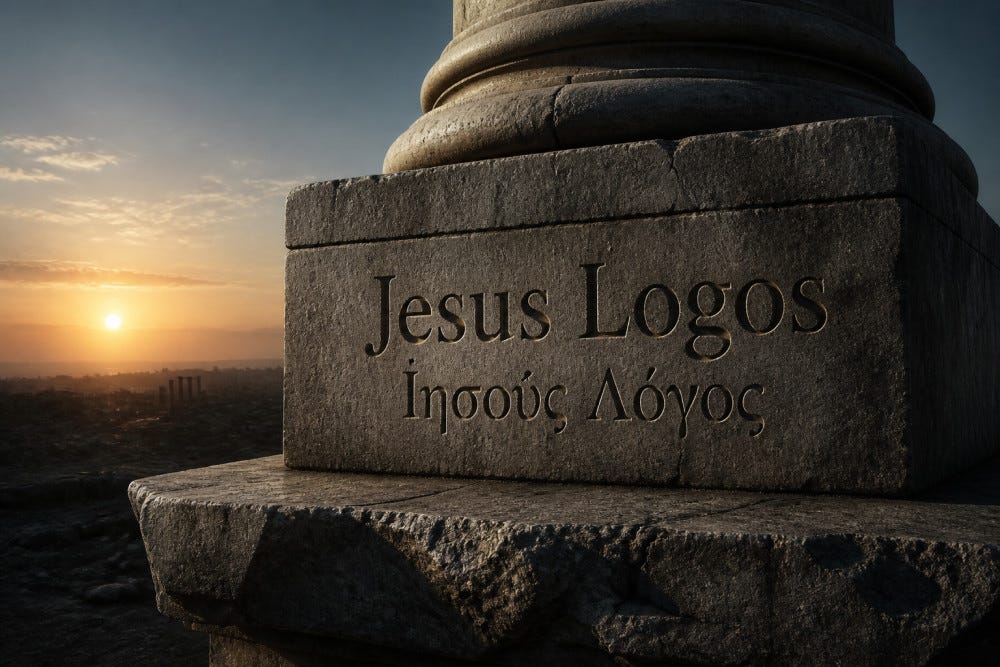
My previous essay argued that Christianity has built its houses on the personality of Jesus rather than on his identity as the Logos, and that this misplacement is the reason contemporary Christianity so easily collapses into a mirror for whatever a culture or a wounded soul needs to see. But there is a second, quieter version of this same error, and it hides not in our devotional life but in our very naming of him. When we say “Jesus Christ,” we are not naming a person; we are naming a person plus an office. “Christ” is not a surname—it is the Greek rendering of “Messiah,” the anointed one, the promised king. Every time we speak the phrase, we are, whether we intend it or not, reasserting a functional claim about his role rather than an ontological claim about his being. And a civilization that has already forgotten what it means for something to be cannot afford to keep naming its God after a job title. If personality is the house and identity is the rock, then “Christ” is scaffolding erected around the house, while “Logos” is the word chiseled into the rock itself.
This distinction is not an innovation but a recovery, and Scripture itself shows us the seam where it was made. In the Pauline epistles and the earlier apostolic writings, “Jesus Christ” functions as a historical argument: it links the man of Nazareth to the office promised by the Hebrew prophets, establishing continuity for an audience that was arguing, fiercely, over whether this particular man could possibly be the long-awaited king. But by the time we arrive at the Johannine corpus, the argument has already been won, and John does something remarkable—he does not open his Gospel with “In the beginning was the Christ.” He opens with the Logos. John is not correcting Paul; he is completing him, moving the conversation from the historical-messianic register into the eternal-ontological one, because the mission of establishing Jesus’s office had, by then, given way to the deeper task of establishing his nature.
It is a category error, then, to treat the sheer statistical frequency of “Jesus Christ” in the New Testament as a permanent mandate for how we must speak of him in every subsequent age. The apostles were writing into a specific apologetic emergency: a world debating whether this man held a particular office. We are not in that world. We are not struggling to convince anyone that Jesus is the Messiah; we are living inside a civilization that has already stripped him of his metaphysical nature entirely and kept only the sentimental residue of the office—a “consensus Christ” who exists to be felt, projected onto, and quietly re-authored by every passing culture. The apostles used the title to establish a fact that their audience doubted. We have inherited the title and used it, unintentionally, to bury the fact that our own audience—ourselves—has forgotten.
There is a simple and almost mechanical principle at work here, one that the law of identity makes visible immediately: if you consistently address a person by their function rather than their name, you will eventually lose the person and be left holding only the function. Call a doctor “Doctor” long enough, exclusively enough, and you stop relating to the human being beneath the coat; you relate to the role, and the role becomes infinitely reinterpretable according to your own need—healer, authority figure, or absent parent, depending on your projection. “Christ” is a role. “Logos” is a name that discloses essence—the rational, causal, self-consistent structure of being itself, the arche through whom all things were made and in whom all things hold together. To insist on “Jesus Logos” is not to reject the biblical text; it is to retrieve, from within that same text, the ontological ground the apostle John assumed and that we, in our present decadence, have almost entirely forgotten.
And this forgetting is not merely academic—it has a precise psychological mechanism, and it is the same mechanism that I have already diagnosed around the drama triangle. When we are taught to “accept Jesus Christ into our hearts,” the operative image, however unconsciously, is of a rescuer arriving from the past to save a victim from a danger the victim cannot handle alone. This is not incidental language; it is structurally identical to the rescuer-victim binary found in the drama triangle, and it invites the believer into precisely the same posture that a helicopter parent invites in a child: I will handle what you cannot handle. I will absorb what you should be facing. The title “Christ” reinforces this posture perfectly, because a Messiah, by definition, is one who intervenes on your behalf. Received this way, the gospel becomes less an invitation to sovereign transformation and more a permanent, cosmic rescue contract—and the believer, however devout, is quietly re-parented into a state of spiritual helplessness rather than raised into the “I can” of rational moral agency.
This is precisely the failure mode described in my previous essay on empathy married to logic: rescue, however lovingly intended, removes ownership of the problem from the person who actually has it, and in doing so manufactures the very Victim it claims to be healing. A gospel preached primarily through the register of “Christ” risks doing exactly this at the level of the soul—it offers relief from consequence rather than alignment with cause, comfort in place of confrontation, and an eternal Rescuer in place of an eternal Logos who invites us to grow into causal, self-governing maturity. The TED Triangle does not ask us to abandon Jesus; it asks us to relate to him as Coach rather than Rescuer, and to ourselves as Creator rather than Victim—and this shift becomes almost impossible while the very name we use to address him keeps re-summoning the Rescuer archetype every time we speak it.
Beneath this lies a deeper and more uncomfortable diagnosis: the widespread appeal of “accepting Christ” is, for many, indistinguishable from the psychological longing for an ever-present mommy or daddy who will finally, permanently intervene and make the frightening world safe. This is not a slander against sincere faith; it is a sober application of the law of non-contradiction to our own devotional language. A person cannot simultaneously be summoning the Logos—the objective, causal structure of reality that governs and matures the self—and summoning an idealized parental rescuer who exists to interrupt causality on their behalf. These are two different psychological postures wearing the same theological word, and the ambiguity in the word “Christ” is precisely what allows both postures to coexist unexamined in the same heart, one masquerading as the other.
“Logos,” by contrast, cannot be so easily misread. One does not “accept the Logos into one’s heart” in the way one accepts a rescuer, because the Logos is not primarily an agent who intervenes from outside; the Logos is the rational and causal ground of being into which one aligns one’s own inner logos, the image of God expressed as rational and causal sovereignty. To invite the Logos in is to submit one’s own faculties of identity, non-contradiction, and causal responsibility to their perfect and eternal source—it is an act of ontological alignment, not a plea for external rescue. This is the rock Matthew’s Gospel describes: not a personality who will show up and hold the flood back for you, but an identity so structurally total that when you build upon it, your own house becomes capable of withstanding the flood itself. A title centered on rescue gives you a rock made of sand dressed as stone; the Logos gives you the rock itself.
None of this requires discarding Jesus’s Messianic office, any more than the prior essay required discarding his personality—it requires rightly ordering our speech so that our thinking is not silently reshaped by an ambiguous title every time we open our mouths. Words are not neutral containers; they are the grammar through which thought is formed and re-formed, and a civilization that keeps calling its God by his function will keep relating to him functionally, as a service to be received rather than a nature to be aligned with. So let this be the small, deliberate discipline going forward: to say “Jesus,” to say “the Logos,” to say “Jesus Logos” when the fullness of the claim is needed—and to let “Christ” recede into its proper, secondary place as a historical footnote about office rather than the primary name by which we address the foundation that our heart’s are built upon. Say the name that discloses the rock, not merely the title that promises the rescue, and watch what begins to grow in you when the house is finally built on true identity rather than external intervention.
Did you enjoy the article? Show your appreciation and buy me a coffee:
Bitcoin: bc1qmevs7evjxx2f3asapytt8jv8vt0et5q0tkct32
Doge: DBLkU7R4fd9VsMKimi7X8EtMnDJPUdnWrZ
XRP: r4pwVyTu2UwpcM7ZXavt98AgFXRLre52aj
POL: 0xEf62e7C4Eaf72504de70f28CDf43D1b382c8263F
THE UNITY PROCESS: I’ve created an integrative methodology called the Unity Process, which combines the philosophy of Natural Law, the Trivium Method, Socratic Questioning, Jungian shadow work, and Meridian Tapping—into an easy to use system that allows people to process their emotional upsets, work through trauma, correct poor thinking, discover meaning, set healthy boundaries, refine their viewpoints, and to achieve a positive focus. Read my philosophical treatise, “The Logocentric Christian,” to learn more about how Greek philosophy, the law of causality, the law of identity, the law of non-contradiction, the law of reason, and Jesus of Nazareth all connect together, my political treatise, “Logocentric Individualism,” for a comprehensive political philosophy based in the Logos, and my philosophic treatise Logocentric Stewardship articulating my call to return to causal alignment with base reality.