
From Drama to Logos: The Architecture of Sustainable Consciousness
You Have No Power Over Me: The Logocentric Refusal
Every statement of capability carries an ontological signature, and learning to read that signature is the beginning of philosophical discernment. The “I can” grounded in truth is not a choice, an attitude, or an act of confidence; it is the inevitable effect of participating in the unmoved mover, the first cause whose self-sustaining nature propagates frictionlessly through every consciousness aligned with it. Truth is causally coherent—it does not require anything beyond itself to exist, it generates effects without contradiction, and it can therefore serve as the ground from which sustainable existence proceeds. The “I can” that emerges from this ground is simply the recognition that the causal pathway exists and that the speaker is already participating in it. The competent builder does not will the house into existence; he perceives the causal chain that leads from materials to structure and walks that chain. His “I can” is a description of his alignment with what is, not an assertion against what is.
The “I can’t” issued as a refusal, by contrast, is not merely a bad strategy or a psychological evasion—it is a logical absurdity at the level of causality itself. A lie cannot function as a first cause, because a lie is by definition dependent on the truth it denies; it requires truth as its precondition in order to be a lie at all. The willful “I can’t” attempts to assert a negation as if the negation were ontologically prior to the reality it negates, but this is structurally impossible. The lie has no ground of its own; it is an effect pretending to be a cause, a consequence pretending to be an origin. When the speaker says “I can’t” as a refusal disguised as an impossibility, he is attempting to make his refusal function as a foundational fact about reality, but his refusal has no foundation—it floats above reality, parasitic on the truth it denies, and the moment its parasitic dependency is examined, it dissolves. The “I can’t” of will is incoherent at the moment it is uttered; its inability to sustain itself is not a future failure but a present logical fact.
This is why foundations propagate the way they do. The unmoved mover is the truthful first cause that causes other causes and effects in a toroidal, self-sustaining fashion. Cause and effect as a universal principle requires this first cause; without it, the entire structure of causality is incoherent. Any consciousness grounded in the unmoved mover therefore participates in coherent causality—its actions produce sustainable effects because the chain is anchored. Any consciousness attempting to ground itself in a lie attempts to initiate a causal chain without a first cause, and the chain therefore has no anchor. Each downstream effect compounds the original incoherence, and the law of non-contradiction does not negotiate. Sooner or later, the false premise will collide with the reality it denied, and the response must be either correction—returning to the unmoved mover—or further fabrication, which only deepens the incoherence. The willful system invariably chooses further fabrication, because correction would expose the original error and threaten the entire structure built upon it. This is the entropy cost of attempting to build on whims: the system requires constant external input to stay coherent, because it has no internal coherence to draw on, because it was never coherent to begin with.
The proper relationship between will and truth must therefore be understood not as a preference but as a metaphysical necessity. Will is not the master who deploys truth tactically; will is the servant that acts within the space the unmoved mover makes available. This is not a constraint on will but the only condition under which will can actually accomplish anything sustainable, because outside this relationship will has no causal purchase. The grounded individual’s “I can” carries weight precisely because it is not a boast; it is the description of a real causal pathway he is already walking. The willful person’s “I can” is loudest precisely when it is least true, because volume must compensate for the absent foundation—the speaker is attempting to manifest through assertion what only alignment with the first cause can actually produce. The first orientation scales without limit because truth is infinite and shareable; the second cannot scale at all in the genuine sense, because it has no ground from which to scale, and what looks like scaling within the willful system is actually the increasingly desperate redistribution of finite resources among parties who have all rejected the only source of genuine generation.
Within the kingdom of lies, the contest becomes an arms race because there is no shared referent to appeal to. When the foundation is whim, the only arbiter is leverage—force, money, social capital, rhetorical violence. The currency shifts depending on the arena, but the structure remains: the biggest liar wins, until a bigger liar arrives. This is why systems built on will rather than logic are perpetually in succession crises and why their leaders are perpetually paranoid. They know the foundation is whim because they put it there, and they know that whoever can outwhim them can displace them. There is no stability because there is no truth to stabilize against. Eventually the willful parties discover that pure individual will is unsustainable—not merely impractical but logically untenable—and they propose a compromise: a set of rules that freezes the current distribution of power and allows mutual coexistence within negotiated bounds.
This compromise has a real historical lineage. The Phoenicians, in their Mediterranean trading networks from roughly 1500 to 300 BC, developed customary commercial practices that became the seed of all subsequent consensus-based law. The Rhodians formalized these practices into the Lex Rhodia, the first systematic body of maritime law, later absorbed by Roman law through Justinian’s Digest. The medieval merchants of Italy, the Hanseatic League, and the Champagne fairs revived and expanded the tradition as Lex Mercatoria—the Law Merchant—supported by codifications such as the Rolls of Oléron and the Black Book of the Admiralty. This entire commercial tradition was built on merchant consensus rather than sovereign authority or divine principle. It was law generated by traders for traders, enforced through reputation and merchant courts. It worked remarkably well, but its foundation was horizontal—party to party—rather than vertical—party to the unmoved mover. The agreement itself was the source of binding authority, and the agreement could dissolve the moment the parties stopped honoring it, because it had no first cause beneath it to hold it together.
The distinction between agreement-grounded order and truth-grounded order becomes the defining axis of civilizational architecture, separating what may properly be called unity consciousness from what may properly be called conformity consciousness. Unity consciousness places truth first and agreement second—participants agree because they have both perceived the same reality, and the agreement is the natural effect of their shared participation in the first cause. Conformity consciousness places agreement first and treats truth as optional, instrumental, or absent—participants agree because they need to coexist, and any truth-claims that survive within the agreement are tolerated rather than foundational. The first produces stable order because the order is anchored to the unmoved mover. The second produces fragile order because the order has no anchor at all; it floats on mutual willingness, and mutual willingness is itself an effect requiring a cause that no party can supply. Agreements have a legitimate role in either system, but they can never occupy the foundational position that belongs to the first cause, because agreements are themselves effects, not causes—they depend on something prior, and when they pretend to be that prior thing, the entire architecture is logically incoherent from the moment it is constructed.
Those at the summit of conformity hierarchies are not freer than those below; they are more thoroughly captured by the concession trap that defines elite positioning. The higher one ascends within a consensus-based system, the more parties of comparable power one must accommodate, because at the top everyone is a fellow heavyweight. The apparent sovereign is actually a hostage to his peers—he must constantly trade, balance, threaten, and yield, because none of them are bound by any principle higher than the agreement, and any of them can defect if the terms tilt too far. The willful “top” enjoys far less freedom than the grounded individual at the bottom, because the grounded individual answers to one master—the unmoved mover—who does not change his mind, does not require flattery, and does not need to be appeased. His “I can” is sovereign because it participates in the first cause; their “I can” is permitted, contingent, and revocable, because it depends on peer consent rather than ontological reality.
This structural difference produces a counter-intuitive consequence: a single individual properly aligned with the unmoved mover can defeat a consortium of immense wills, because the consortium is internally subdivided by its own concession-structure while the aligned individual is internally unified by his participation in the first cause. The consortium’s power is the sum of its members’ wills minus the friction of their mutual concessions, the energy spent maintaining the agreement, the leakage of defection threats, and the inability to commit fully to any course of action. The aligned individual’s power is the full magnitude of his alignment with reality, undiluted by negotiation with peers, because his only “peer” is the truth itself—and the truth does not negotiate. His submission is not to other wills but to the structure of reality itself, and by submitting to what is, he becomes a coherent channel through which the first cause propagates effects.
The universal first principles—identity, non-contradiction, cause and effect, the law of reason—are often misperceived as constraints on freedom, as if they were external rules imposed on an otherwise unbounded will. The Logocentric understanding corrects this: these principles are the architecture of the unmoved mover’s self-expression, the load-bearing walls of reality itself. To follow them is not to submit to a foreign authority but to recognize the structure within which any coherent action whatsoever can occur. The willful man who rejects them is not freer—he is attempting to act outside the structure of causality, which means his apparent actions are not actually actions at all but only the brief, decaying motions of a system that has no ground beneath it. His “I can’t” reveals itself as the truth about his condition: he literally cannot, because he has severed himself from the only source of genuine capability. Agreements that violate the first principles do not transcend them; they simply guarantee that the agreement will fail in ways its parties cannot diagnose, because they have agreed to be blind to the cause.
Current civilization operates increasingly on the structural logic of the reality television show Survivor, where alliances are formed on the basis of convenience rather than principle, public performances of loyalty mask private calculations of advantage, and the winner is not the most capable or most honest participant but the one who navigated the social terrain most adeptly. This pattern operates not just in entertainment but throughout corporate hierarchies, political parties, academic departments, religious institutions, and increasingly even families and friendships. The currency varies—social capital, money, credentials, attention, institutional position—but the game mechanics are remarkably uniform: read the alliance map, position yourself within a majority bloc, perform the rituals of belonging, identify threats, coordinate their elimination, repeat. The participants often do not consciously experience themselves as playing this game; they experience themselves as being practical or realistic. But the structure of their behavior is indistinguishable from contestants who know exactly what they are doing.
A small but significantly powerful stock of Logocentric individuals exists within this field, but the field itself has been tuned to power and lies, which means these individuals are essentially swimming upstream at most times. The field rewards certain frequencies and dampens others. A truthful statement made into this field often produces no resonance, while a strategically positioned falsehood produces immediate amplification. A genuine offer of value is treated with suspicion, while a manipulative pitch is treated as the expected baseline. The Logocentric individual is not imagining the resistance; he is correctly perceiving that the medium itself has been adjusted to favor different operations than the ones he is performing. His “I can” runs against the grain of a field that rewards the strategic “I can’t”—even though the field’s tuning cannot change the ontological fact that his “I can” is causally coherent while their “I can’t” is causally incoherent. The tuning produces local distortion, not metaphysical reversal.
The field is structured to offer this individual a concession bargain: accept a handful of false premises, soften a few principled positions into “nuance,” refrain from naming a few obvious truths, and the headwinds will slacken while the doors open. The offer is rarely explicit; it is communicated through patterns of who gets promoted, invited, funded, published, and celebrated. Many Logocentric individuals take this deal, often without noticing, because the concessions are presented as minor, contextual, or temporary. Each concession seems individually defensible, but each one slightly severs the individual from the unmoved mover and substitutes a horizontal dependency in its place. He gains apparent position and loses ontological ground. And the goalposts never stabilize—the concessions that bought entry in one decade become insufficient in the next, requiring perpetual additional concessions, each one carving a little more from the foundation he originally stood on.
The parasitic class that occupies the upper ranks of the conformity hierarchy enslaves others through increasingly sophisticated and intricate means, but this enslavement is the direct expression of their own captivity. The parasite at the top is the most thoroughly enslaved being in the entire arrangement, because his position depends on continuously outmaneuvering peers of comparable will, each of whom is doing the same calculation about him. He cannot rest, cannot trust, cannot drop his guard. The predation flows downward not from strength but from desperate compensation for the predation he is himself absorbing horizontally. The increasing sophistication of enslavement methods is not a sign of growing power but of growing desperation, because the most reliable enslavement is the one the enslaved do not perceive. Each new layer of control is added because the previous layer began to be perceived, and the same intricacy that binds the slaves more thoroughly also binds the parasites more thoroughly.
The archetype that emerges at the summit of this hierarchy is the master negotiator, who operates entirely within the horizontal plane, reading the field of wills and repositioning them relative to one another to extract advantage from the gaps between them. His brilliance lies in perception of the immediate leverage points, the willingness to make and break alliances, the ability to exploit the concession-structure that all willful parties are trapped within, and the capacity to move faster and more ruthlessly through the space of peer calculations than his competitors. He is supremely skilled at the game of Survivor, which means he is supremely skilled at a game that has no first cause beneath it. His negotiation is the art of managing the horizontal—getting other wills to yield just enough to preserve the illusion that something is being built, when in fact only redistribution is occurring. The master negotiator is therefore anti-Christ in the precise theological sense: he is the master of the fallen order, the prince of this world whose domain is the realm of competing wills and whose greatest victories are only rearrangements of decay. His “I can” is the loudest precisely because it is the most hollow, because every negotiated victory requires him to immediately begin the next negotiation, the next adjustment, the next management of the peer architecture that owns him even as he appears to own it.
The master builder, by contrast, operates along the vertical axis, aligned with the unmoved mover and therefore with causality itself. His work is not to manage other wills but to perceive the causal pathways that already exist and to walk them, to bring materials into alignment with the structure they are meant to embody, to generate rather than redistribute, to create conditions in which life can flourish rather than negotiate the terms of its decay. His “I can” is quiet because it requires no assertion—the building stands, the structure holds, the effects propagate without friction because they are grounded in the first cause. He does not need to renegotiate with peers because his work does not depend on peer consent; it depends only on alignment with what is. The master builder is the Christ figure precisely because he has submitted entirely to the unmoved mover and thereby become the transparent channel through which the first cause builds reality itself. Where the master negotiator exhausts himself managing an increasingly complex web of concessions and threats, the master builder conserves his energy for the work itself, because the work generates its own coherence from the ground up. The negotiator’s victories are provisional and require perpetual defense; the builder’s work is permanent because it was never dependent on the permission of other wills to be real.
The ancient name Beelzebub—lord of the flies—captures the actual metaphysical position of those who follow the track of will as a foundation, the master negotiator’s destination once the negotiations have run their course. The etymology is not incidental; it is diagnostic. Flies are scavengers, parasites, beings that subsist on what is already dying or dead. Their “lord” is the master of decay, the figure whose dominion is exercised only over what is in the process of dissolving. Those who pursue supreme will, in their desperate attempts to become a “lord” akin to God, do not actually attain the divine position they imagine; they strip themselves of all Logocentric dignity in the climb and arrive at the summit having become nothing more than rulers of flies, shit, and decay. They cannot rule what is alive, because life flows from the unmoved mover they have rejected; they can only rule what is dying, which is why the institutions, cultures, languages, and relationships they capture are progressively hollowed and coarsened. The acceleration of decay across captured domains is not a side effect of their rule; it is its necessary precondition, because their authority extends only over what has already entered the appropriate state of decomposition. Measured against a single Logocentric individual who stands grounded in the first cause, these self-appointed lords are small and insignificant—they have traded the substance of being for the costume of dominance, and what looks like a throne from inside the willful system looks, from outside it, like a perch on a mound of rot.
The deepest captivity of this class is that they cannot defect from their function, even when continuing accelerates their own destruction. A coherent slaveholder might theoretically retire from the role; the parasitic class operates within a peer structure where retirement is not permitted, because the peers will not permit it. To withdraw from the game is to expose oneself to predation by those still playing, and the only protection from peer-predation is continued participation in peer-predation. This produces the strange spectacle of immensely powerful figures making choices that are obviously self-destructive at the civilizational scale, often appearing aware that they are doing so, yet continuing anyway. The slave at the top has lost even the option of escape—his “I can’t” has finally become genuine, but not in the way truth’s “I can” is genuine. His “I can’t” is the recognition that he has severed himself from the first cause and now has no actual capability of his own; he can only perform within the increasingly narrow constraints of a peer architecture that itself has no ground.
Yet this entire descent, when surveyed from sufficient height, begins to reveal itself as something other than pure catastrophe. The instruction in the Garden of Eden was to avoid eating from the tree of the knowledge of good and evil, and the knowledge in question is precisely the knowledge of morality itself—the comprehensive understanding of what truth means and what lies mean, what good is and what evil is, as living realities rather than abstract concepts. But morality cannot be genuinely comprehended from one side of itself alone; the comprehension requires contrast, and the contrast requires that the consciousness pursuing the knowledge must actually engage with the lying it seeks to understand. Every forbidden fruit in human experience is, at its core, a seed of truth wrapped in the deceptive flesh of a lie, and the long human journey through these fruits is the process of biting through the flesh, eventually recognizing what the lie was, and discovering the seed of truth that the lie had been concealing. Lust conceals the seed of genuine union; greed conceals the seed of genuine value; arrogance conceals the seed of genuine sovereignty; envy conceals the seed of genuine recognition. Each one, fully eaten and fully digested, eventually delivers its hidden seed once the consciousness has matured enough to separate the seed from the flesh.
What this implies is that the ultimate forbidden fruit—the one that remains after all the other forbidden fruits have been bitten through and their seeds recovered—is lying itself. All the other fruits were specific lies wrapped around specific truths; the final fruit is the very practice of lying, the meta-mechanism that made all the other fruits possible. And the prohibition against eating from the tree of the knowledge of good and evil was never a simple command to remain ignorant; it was a warning that this particular tree could only be understood through the long, costly, painful process of eating from it, suffering its consequences, and eventually returning. The prodigal son does not become the prodigal son by staying home; he becomes the prodigal son by leaving, by squandering, by descending to the lowest condition, and by returning with knowledge his stay-at-home brother does not possess. The descent into willful, lying, conformity-based existence is not the failure of humanity; it is the necessary education through which humanity comes to genuinely comprehend what truth means by experiencing, exhaustively, what its absence produces—and what the absence of the first cause feels like when one has tried to live without it.
This recontextualizes the entire architecture of decay described above. The Survivor dynamics, the parasitic hierarchies, the concession bargains, the lords of flies and rot—these are not merely indictments of the willful system but descriptions of the curriculum through which consciousness learns the actual taste of the final forbidden fruit. The conformity hierarchy is not the destination; it is the lesson. The unsustainability is not the tragedy; it is the proof that the system has no first cause beneath it. The depravity is not the end-state; it is the contrast that makes the eventual return meaningful. Consciousness that has only known truth abstractly does not yet know what truth is; consciousness that has lived inside the lie and watched it collapse from within, and then returned to truth, knows truth in a way that pre-fall innocence cannot. The “I can” that emerges after the prodigal return is structurally different from the “I can” that never left—it has been tested, contrasted, and confirmed against everything that would have unmade it, and it now carries the weight of someone who has personally verified that the unmoved mover is the only ground from which anything coherent can be said or done.
The veil of blindness (Sam-a-el, aka “the blind god”) that contemporary humanity treats as the unalterable condition of consciousness is therefore not an inherent feature of existence but the cumulative residue of will submitting to will rather than to the first cause—the accumulated debris of the long curriculum being worked through. Every concession to a false premise leaves a small distortion in the perceptual field. Every alliance built on calculation rather than truth leaves a small obscurity in the relational field. Every performance maintained for strategic advantage leaves a small fog in the communicative field. Multiply these across a lifetime and a civilization, and the result is the dense veil that people come to treat as default reality. Opacity is the accumulated debris of unaddressed lying, and clarity is the natural state that emerges the moment the lying stops—because the moment the lying stops, the consciousness re-aligns with the unmoved mover, and the first cause’s effects begin propagating through it again without friction.
In unity consciousness with other unique individuals, the entire domination-submission dynamic resolves itself through vertical reorientation. Submission is no longer the degrading act of yielding to another finite, fallible, willful being; it is the recognition of one’s own actual condition relative to the structure of reality itself, the recognition that capability flows from participation in the first cause and nowhere else. Two individuals who have both submitted vertically meet on entirely different terms than two individuals locked in horizontal struggle. Neither needs to dominate the other, because neither derives his identity from his position relative to the other. Their relationship can finally be what relationship was always meant to be: mutual recognition between beings who are each separately grounded in something greater than either of them. The hierarchy that emerges in this condition is not coercive but accurate—each participant recognizes his actual position relative to alignment with the unmoved mover, and the recognition is mutual, evident, and unresented.
When two Logocentric individuals encounter one another, the encounter has a quality of mutual visibility that conformity consciousness rarely experiences. There is no performance, because performance is unnecessary—neither party is establishing position relative to the other. There is no concealment, because concealment is unnecessary—neither party is extracting advantage from information asymmetry. What remains is direct perception: I see you, you see me, and both of us see the truth that stands between us as the actual subject of our exchange. This visibility is the natural effect of two beings who have stopped lying meeting in a space where the lies that normally distort perception are not present. The hierarchy that organizes such individuals does not require enforcement, because each participant recognizes his actual position in it and assents to it without resentment. The hierarchy is evident because alignment is evident.
The reliance on punitive measures is itself a symptom of the veil rather than a remedy for what produced it. Punishment is required when the perpetrator does not perceive the truth of what he has done, when his consciousness is so fogged that the natural consequences of his action are invisible to him, when external pain must be applied because internal recognition has been blocked. In unity consciousness, the role normally played by punishment is performed by perception itself. When an individual perceives the truth of what he has done with the veil dissolved, the recognition is itself the correction. He does not need to be punished into changing his behavior, because he has seen what his behavior actually is, and the seeing is the change. This is the genuine meaning of epiphany: the moment at which a previously veiled portion of reality becomes directly visible, producing an irreversible reorganization of consciousness. The epiphany cannot be argued with, cannot be unseen, and cannot be reversed once it has occurred, because it is the moment at which consciousness re-contacts the unmoved mover and recognizes that everything else has been derivative of it all along.
The condition described throughout this progression is not merely personal; it is a statement of lawfulness against the legalities that attempt to govern it. Lawfulness is the structure of reality itself, the coherent pattern that emerges when consciousness aligns with the first cause and allows it to propagate through action. It is the law that governs cause and effect, identity and non-contradiction, the sustainability of systems grounded in truth. Legality, by contrast, is the agreement-based simulacrum, the horizontal arrangement of competing wills who have negotiated a temporary freeze on their mutual predation and dressed it in the language of binding authority. The legal system claims to have power over the Logocentric individual, to bind him through statutes and codes and enforcement mechanisms, but this claim is metaphysically baseless. The legal system has power only over those who accept its premise—that agreement can generate obligation, that fiat can create binding force, that the horizontal consensus of parties without a first cause can establish what is permitted and what is forbidden.
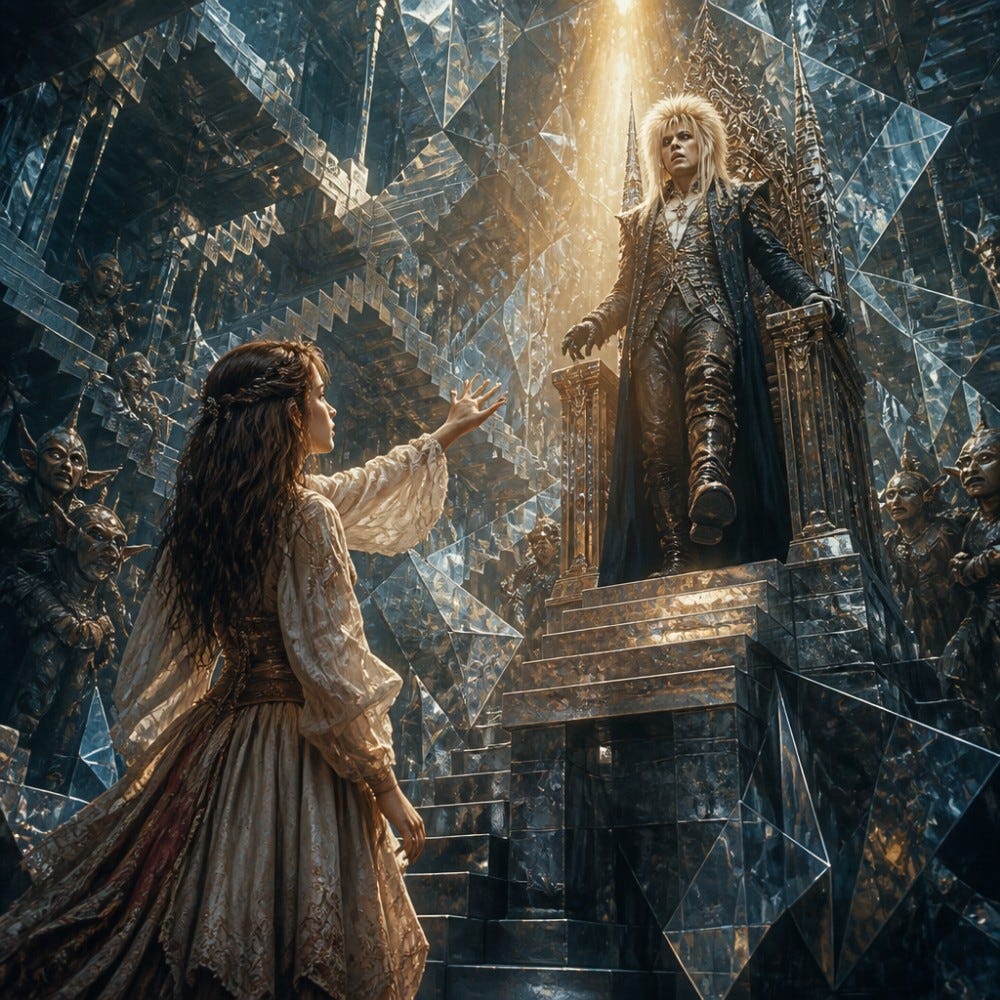
The individual founded in lawfulness recognizes that the legal system is attempting to impose effects without a cause, to bind without grounding, and therefore he can move through it knowing that its claims to authority are empty. This is the truth the protagonist in the Jim Henson movie Labyrinth recognizes when she speaks her ultimate statement to Jareth: “you have no power over me.” She has moved through his maze, engaged with his illusions, suffered his tests, and discovered that his power over her was never real—it was only the power of her own assent, her own belief that his constructed reality was binding. The moment she recognizes the fiction, the moment she withdraws her participation in the legality he has constructed, his entire dominion collapses. The Logocentric individual moving through the conformity system performs the same operation repeatedly, but rarely with the same overt declaration: he engages with each forbidden fruit, bites through the flesh of the lie, recovers the seed of truth that was concealed, and in doing so he demonstrates—without needing to broadcast it—that the lie had no actual power, that the legality that protected the lie has no jurisdiction over the truth.
This demonstration is not performed through verbal defiance or public declaration. It is performed through cunning navigation of causality itself, through moving within the legalities with the mask of superficial compliance while maintaining internal alignment with the unmoved mover. Like Viktor Frankl in the concentration camp, the Logocentric individual refuses to allow his internal coherence to be colonized by the system’s attempt to bind him; he picks his battles, conserving energy for what matters, and he navigates the fiat laws by understanding them as logically incoherent structures that collapse under their own weight when approached with the laws of cause and effect, non-contradiction, and identity. The statement “you have no power over me” is not broadcast to the masses but demonstrated through invisible trajectories—the way he moves through the system without being captured by it, the way he builds real things alongside the system’s decay, the way he recovers seeds of truth from each forbidden fruit without allowing the system’s legalities to define what truth is. He does not assault the citadel; he simply refuses to be imprisoned by it.
The legality senses the non-compliance not through confrontation but through the uncanny fact that some individuals simply cannot be bound, cannot be corrupted, cannot be made to serve ends that contradict the first cause, and their visible existence in this condition—quiet, dignified, unshakeable—is the contagion that slowly destabilizes the entire architecture. The condition described throughout this progression—where will submits to the unmoved mover rather than to other will, where agreements rest upon truth rather than displacing it, where hierarchy is recognized rather than imposed, where perception replaces punishment, where the veil dissolves because the lying that generated it has stopped—is not a Utopian construct but the natural condition of the prodigal consciousness returning to itself after the long curriculum of the forbidden fruits. The “I can” that defines this condition is not a choice the returned consciousness makes; it is the inevitable effect of its renewed participation in the first cause, the frictionless propagation of truth through a channel that has finally stopped obstructing it.
The “I can’t” that defined the willful descent is revealed in retrospect as exactly what it always was: a logical absurdity that could not have sustained itself even for a moment, except that the consciousness uttering it was willing to keep adding new lies to prop up the original incoherence. The work is not to construct something new but to complete the prodigal return—to recognize that every “I can’t” was a refusal masquerading as causality, that every lie was a forbidden fruit concealing a seed of truth, and that the seeds, once recovered and integrated, build the foundation for an “I can” that the pre-fall consciousness could not have spoken with the same weight. When this return reaches sufficient threshold within a civilization, what remains is what was always there beneath the veil, but now possessed in a way that only the returned can possess it: beings who can see each other clearly, who can coordinate without coercion because their coordination is grounded in shared participation in the unmoved mover, and who discover that what remains when the lying stops is enough—is, in fact, everything that was ever needed, and everything the long descent into and back from madness was teaching them to recognize.
Check out the song that accompanies this article, “You Have No Power Over Me!”
Did you enjoy the article? Show your appreciation and buy me a coffee:
Bitcoin: bc1qmevs7evjxx2f3asapytt8jv8vt0et5q0tkct32
Doge: DBLkU7R4fd9VsMKimi7X8EtMnDJPUdnWrZ
XRP: r4pwVyTu2UwpcM7ZXavt98AgFXRLre52aj
POL: 0xEf62e7C4Eaf72504de70f28CDf43D1b382c8263F
THE UNITY PROCESS: I’ve created an integrative methodology called the Unity Process, which combines the philosophy of Natural Law, the Trivium Method, Socratic Questioning, Jungian shadow work, and Meridian Tapping—into an easy to use system that allows people to process their emotional upsets, work through trauma, correct poor thinking, discover meaning, set healthy boundaries, refine their viewpoints, and to achieve a positive focus. Read my philosophical treatise, “The Logocentric Christian,” to learn more about how Greek philosophy, the law of causality, the law of identity, the law of non-contradiction, the law of reason, and Jesus of Nazareth all connect together.