
Logocentric Stewardship: The Demotion of Will and the Sovereignty of Process
A Philosophical Treatise on the Final Act of Will, the Architecture of “I Can,” and the Return to Causal Alignment

Introduction
This treatise is the third pillar in a philosophical architecture that began with The Logocentric Christian and continued through Logocentric Individualism. The first treatise established the metaphysical and moral foundation: the primacy of the Logos, the laws of identity, non-contradiction, and causality as the ground of morality, the crucifixion as the final proof of non-contradictory identity, and the earned innocence of the sovereign soul. The second treatise extended that foundation into the political domain, constructing a constitutional, judicial, and economic architecture grounded not in utility or will but in the laws of thought themselves.
This third treatise addresses the most fundamental premise of all—the premise that silently governs which of the previous two architectures a person actually inhabits. It asks a single, decisive question: what sits at the foundation of your being—will or truth? The answer determines not merely what you do but what kind of creature you are. It determines whether your nervous system lives in a state of perpetual emergency or in the unhurried pace of building. It determines whether your relationships are transactional battlegrounds or non-transactional communions. It determines whether your religion is a willpower game dressed in divine language or a genuine alignment with the Logos. And it determines whether your politics is a contest of domination or a cooperative stewardship of process.
The telos of this treatise is Logocentric Stewardship—the way of being that emerges when will has been demoted from the architect of reality to the steward of process, when “I will” has been replaced by “I can” as the foundational premise, and when the individual operates not as a frustrated tyrant trying to edit reality by decree but as a sovereign builder who discovers what is possible through patient, causal, unforced labor.
Part I: The Foundational Premise
Chapter 1: The False Sovereignty of “I Will” vs. The True Sovereignty of “I Can”
The Two Foundational Verbs
There are two foundational verbs that organize a human life, and the difference between them determines whether a person spends their days creating or coercing. These two verbs—“I will” and “I can”—are not mere psychological dispositions. They are metaphysical premises, and the choice between them is the most consequential decision a human being can make, because every subsequent thought, emotion, action, and relationship deductively flows from it as an effect flows from a cause.
The Builder archetype is the personality gestalt that begins with “I can.” The Builder is the sovereign individual whose primary orientation toward reality is one of capacity—of latent power waiting to be expressed through patient work along the grain of reality. The Builder says, in effect, ‘I can grow a garden,’ and immediately recognizes that this means preparing the soil, sowing seeds at the proper depth and season, watering consistently, and allowing the plants to mature through the sequence that causality demands. The Builder’s statement of capacity implicitly bows to causality. It acknowledges that effects follow from causes, that a thing must be grown, forged, or earned through a sequence of real steps that cannot be skipped. No amount of wanting will let the Builder harvest fruit from seeds he has not planted or water he has not applied. The Builder’s confidence is not in his decree but in his alignment with how things actually work.
The Negotiator archetype is the personality gestalt that begins with “I will.” The Negotiator is the individual whose primary orientation toward reality is one of intention—an intention that has already skipped past the question of whether reality permits it. The Negotiator says, in effect, ‘I will have this garden,’ and treats the gap between desire and result as an inconvenience to be overpowered and forced rather than a structure to be respected. “I will” is a statement that has decided the outcome in advance and now demands that the world rearrange itself to comply. The Negotiator’s confidence is in his decree, not in causality, and this is precisely why the Negotiator is perpetually frustrated: reality keeps presenting him with a process he refuses to honor, and he mistakes that friction for opposition rather than instruction.
The Metaphysical Inversion
This distinction is not merely psychological—it is metaphysical. “I can” implicitly bows to the law of causality. “I will” attempts to replace it. The law of causality—that every effect proceeds from a cause according to the nature of that cause—is not a convention that can be overridden by sufficient determination. It is the structure of reality itself, the grammar by which the Logos—the ordering principle of reality, the rational structure that makes existence intelligible—operates. When the Builder says “I can,” he is aligning his inner logos with the Universal Logos. When the Negotiator says “I will,” he is attempting to usurp the Universal Logos with his own private decree.
This usurpation is what we name Fiatism, after the Latin fiat—“let it be done.” The Fiatist is the one who says “Let it be so” and expects the universe to obey, as though sovereignty over outcomes could be exercised by administrative declaration. It is the bureaucratic temperament elevated to a metaphysics: the belief that reality is a ledger to be edited rather than a causal order to be navigated. The Fiatist replaces causality with will, willpower, and finally the will to power. He does not ask how a desired thing can be brought into being through patient alignment with reality; he simply decrees that it shall be, and then expends enormous energy compelling people and circumstances to comply with his decree.
Fiat money, fiat law, fiat truth—all share this signature: value, legitimacy, and reality conjured by pronouncement rather than produced by the slow, honest labor of cause meeting effect. The Fiatist is the one who prints currency and calls it wealth, who passes a law and calls it justice, who declares a consensus and calls it truth. In every case, the mechanism is identical: the bypass of causality through decree.
False Sovereignty vs. True Sovereignty
The “I will” premise produces a false sovereignty—a sovereignty that depends on the continuous exercise of force to maintain outcomes that causality did not produce and cannot sustain. It is the sovereignty of the man who must keep shouting his authority because his authority has no ground. It requires constant energy, constant vigilance, and constant coercion, because at every moment reality is pushing back against the decree, attempting to restore the causal order that was bypassed.
The “I can” premise produces true sovereignty—a sovereignty that depends on nothing but alignment with what is. It is the sovereignty of the man who has prepared the soil so well that the garden thrives on its own. It requires energy, but the energy is generative rather than coercive. It is the energy of cultivation, not the energy of imposition. The Builder’s sovereignty is stable because it is an effect of his alignment with causality, not a violation of it.
This distinction maps directly onto the concept of permissioned liberty versus inherited liberty. Permissioned liberty is the liberty granted by an external authority—the state, the church, the institution, the parent—and is therefore a state of dependency that negates causal agency. It is the liberty of “I will” applied at the political level: freedom by decree, revocable at the decree-giver’s pleasure. Inherited liberty is the ontological liberty that belongs to the sovereign individual by nature of their creation in the imago Dei—the liberty that precedes all political arrangements and cannot be legitimately revoked. It is the liberty of “I can”: freedom discovered through causal alignment, sustained by the individual’s own integration, and immune to the decrees of those who have not earned the authority to grant or withhold it.
The false sovereignty of “I will” and the true sovereignty of “I can” represent two entirely different jurisdictions. “I will” operates in the jurisdiction of force, where outcomes are imposed and maintained through the continuous expenditure of power-over. “I can” operates in the jurisdiction of truth, where outcomes are grown and sustained through the patient exercise of power-within and power-with. The shift from one jurisdiction to the other is not a policy change but a metaphysical revolution—a revolution that begins with a single, paradoxical act.
Chapter 2: The Survival-Ego as Will to Power vs. The Sovereign Ego as Truth and Innocence
Two Egos, Two Foundations
The distinction between “I will” and “I can” is not abstract. It is embodied in two fundamentally different forms of the ego (individuality)—the organizing center of a person’s identity. The survival-ego is the default state of a consciousness identified with the physical body and its needs, fears, and appetites. It is the ego built from the outside-in, a fragile construct assembled from external threats, social pressures, and the urgent demands of biological survival. Its foundational premise is “I will”—the decree that reality must conform to the survival-ego’s preferences, because the survival-ego cannot survive the discovery that it is not in control.
The sovereign ego is the willed achievement of a consciousness that has identified with the Logos rather than the body. It is the ego built from the inside-out, a fortress of character forged through the disciplined application of the laws of thought to the self. Its foundational premise is “I can”—the discovery of what is genuinely possible through alignment with causality. The sovereign ego does not demand that reality conform to its preferences; it conforms itself to reality and discovers, in that conformity, a power far greater than any decree could produce.
The survival-ego is the will to power. It is the Nietzschean impulse stripped of its romantic grandeur and revealed for what it actually is: the desperate flailing of a consciousness that has grounded itself in the perishable and must therefore perpetually fight to maintain the illusion of control. The sovereign ego is truth and innocence—not naiveté, but the love of truth uncontaminated by the survival-ego’s demand to bend reality to its preferences. Innocence, in this context, is the orientation that values alignment with the Logos above the satisfaction of any particular desire, including the desire for power, vindication, and control.
Old Individuality vs. New Individuality
The survival-ego produces a specific kind of individuality—what we might call old individuality. This is the individuality of the Negotiator: the person who defines themselves by their capacity to impose their will, to extract value, to win the contest of wills. It is an individuality rooted in differentiation through domination. The old individual must constantly prove their existence by prevailing over others, because their identity has no ground independent of the contest. Remove the contest and the individual dissolves.
The sovereign ego produces new individuality—the individuality of the Builder. This is the individuality of the person who defines themselves by their capacity to create value, to align with identity, non-contradiction, and causality, to build structures that endure. It is an individuality rooted in differentiation through construction. The new individual does not need to prevail over others to exist; their identity is grounded in their alignment with identity, non-contradiction, and causality—which is self-sustaining and does not require the defeat of anyone.
This distinction has profound implications for the earned I AM identity—the coherent identity achieved through the rigorous application of the three laws of thought (identity, non-contradiction, and causality) to the self, grounding one’s existence in objective reality rather than performative declaration. The survival-ego’s “I AM” is performative: it asserts identity without the underlying continuity of tested existence. It is the “I will be seen as” rather than the “I am.” The sovereign ego’s “I AM” is earned: it is the product of a continuous internal audit that ensures strict alignment between stated principles and actual conduct, eliminating the psychological fractures that invite external manipulation.
The shift from old individuality to new individuality is the shift from “I will” to “I can” at the deepest level of the self. It is not a change of opinion but a change of ontological foundation. The old individuality is constituted by will; the new individuality is constituted by truth. And the transition between them requires an act so paradoxical that it can only be described as the metaphysical pivot of the entire Logocentric framework.
The Ontological Spectrum and the Incarnational Crucible
The shift from the “I will” premise to the “I can” premise is not always a singular, instantaneous event that instantly reorders one’s external reality. In a fallen world still dominated by the survival-ego and the architecture of Fiatism, the transition manifests as a tripartite ontological spectrum. This spectrum maps the locus of human consciousness across its relationship to the Universal Logos (the Divine) and the causal realm (the Earth). See image below.
The Fallen State: The Survival-Ego’s Fiatism
The shift from the “I will” premise to the “I can” premise is not always a singular, instantaneous event that instantly reorders one’s external reality. In a fallen world still dominated by the survival-ego and the architecture of Fiatism, the transition manifests as a tripartite ontological spectrum. This spectrum maps the locus of human consciousness across its relationship to the Universal Logos (the Divine) and the causal realm (the Earth). See image below.
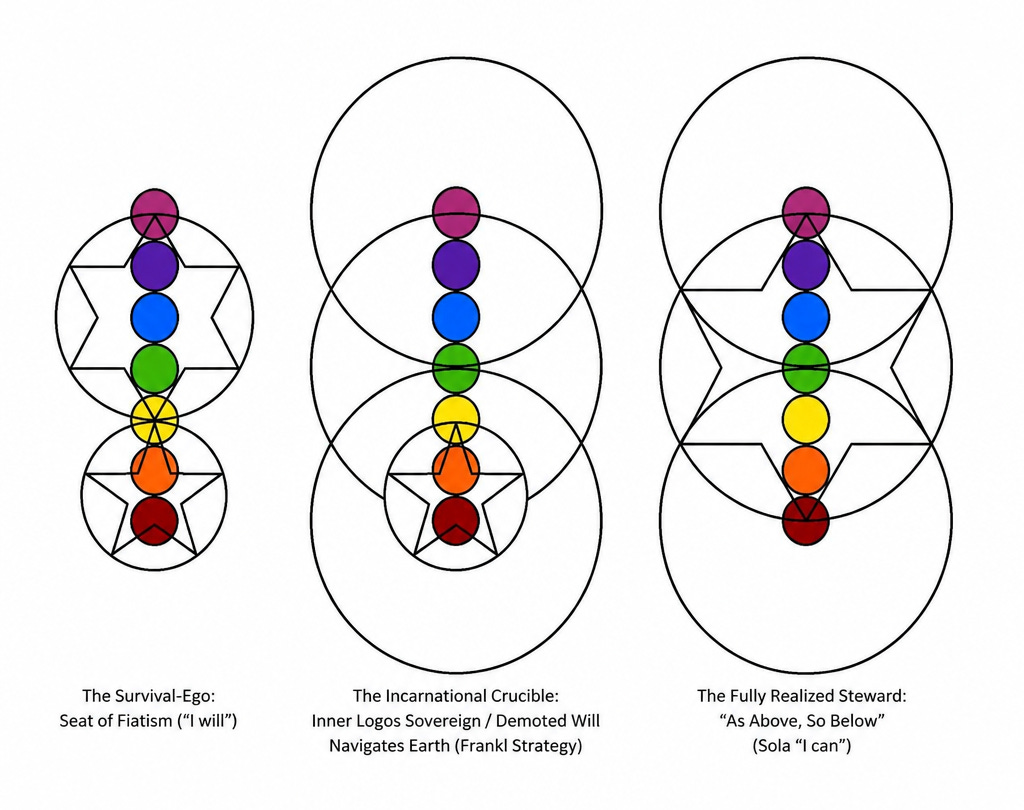
On the far left of this spectrum is the orientation of the typical human creature, governed entirely by the survival-ego. Here, the seat of the “I will” premise—the ego’s will to power—dominates the individual’s entire being. It dictates not only their navigation of the earthly realm but also corrupts their relationship to the Divine. The individual attempts to relate to the Universal Logos not through submission to truth, but through the same fiat, transactional, and coercive mechanisms they use to manipulate the earth. This is the “I will” premise operating at maximum capacity, resulting in a life perpetually at war with both reality and the Divine.
The Incarnational Crucible: The Frankl Strategy
The middle stage of the spectrum represents the incarnational reality of the sovereign individual who has dethroned the will internally but must still navigate a physically hostile, fallen world. Here, the seat of the inner Logos—the green locus of Sophrosyne and the “I can” premise—becomes the supreme center of identity. The individual is fully connected to truth and the Divine in their thinking, spiritual, and moral dimensions.
However, because the physical body remains vulnerable to the physical harm inflicted by the “I will” premise of others, the individual must still engage with the earthly realm through the tactical, demoted will. This is not a contradiction; it is the Internal Non-Compliance (Frankl Strategy)—the absolute refusal to surrender the inner Logos to hostile fiat structures while superficially complying with them—elevated to incarnational survival. Great historical figures who maintained sovereign cores under the threat of physical annihilation—from Jesus Christ to Aleksandr Solzhenitsyn, to Viktor Frankl in the concentration camps—operated precisely in this middle state. They maintained absolute, unassailable alignment with the Universal Logos internally (the “I can”), while strategically deploying the demoted will to navigate, endure, and sometimes physically survive the earthly games of dominance (the “I will”). For the thinking non-conformist navigating a world of physical threats, this middle state is the necessary crucible: the inner core remains sovereign and unbroken, while the demoted will acts as a tactical steward to protect the vessel.
The Fully Realized Steward: As Above, So Below
On the far right of the spectrum is the fully realized individual who has achieved Logocentric Substance. Here, the “I will” premise has been entirely dissolved and replaced by the “I can” premise in both the divine and the earthly realms. The Principle of Correspondence (“as within, so without”) is fully actualized. The individual’s relationship to the earth is no longer navigated through the emergency friction of the will to power, but through the unhurried, causal alignment of true stewardship. The inner Logos and the outer actions are in perfect, non-contradictory harmony. The garden is tended not by decree, but by the quiet, unstoppable competence of a consciousness that has fully returned to its proper ontological status.
Chapter 3: The Paradox of Dethroning Will
The Final Act of Will
Dethroning the will requires a paradox: it takes one final act of will to say, “I will no longer play the willpower game.” This is the sword laid down deliberately rather than knocked away. It is the inner logos recognizing its own limits and refusing to usurp the Universal Logos. By using will to destroy the primacy of will, you clear the foundation. You do not amputate the will; you demote it from the architect of earthly reality to the steward of process. This exact demotion is the mechanism that propels the individual from the fallen state of the survival-ego into the incarnational crucible. It is the precise moment the inner Logos takes the throne, leaving the demoted will to serve as the tactical steward that must now navigate earthly friction.
This act is not hypocrisy. It is the recognition that the same tool that built the prison must be used to open the door. The will that spent years decreeing outcomes, imposing preferences, and fighting reality is the only instrument available to the individual at the moment of transformation. But the act of using will to end the primacy of will is categorically different from every previous use of will, because it is the one act of will that does not attempt to edit reality. It is the act of will that says, “Reality, you win. I will no longer fight you. I will learn from you.” It is the surrender that is simultaneously the greatest assertion of sovereignty, because it is the sovereign individual choosing—freely, deliberately, with full awareness of the cost—to place truth above will at the foundation of their being. In making this surrender, the individual does not instantly evaporate the physical hostility of the world. Rather, they solidify their position in the middle stage of the ontological spectrum: their inner core is fully sovereign and aligned with the Divine, while their demoted will remains active to tactically navigate, endure, and execute the Frankl Strategy within the earthly games of dominance.
Will After the Foundation
What replaces will at the foundation is truth—specifically, truth as demonstrated by the laws of identity, non-contradiction, and causality, and disciplined by the eight universal intellectual standards (clarity, accuracy, precision, relevance, depth, breadth, logic, and fairmindedness) and the eight intellectual character traits (intellectual humility, courage, empathy, autonomy, integrity, perseverance, confidence in reason, and fairmindedness). These are not arbitrary rules; they are the structure of reality made explicit, the grammar by which “I can” learns what is genuinely possible.
When truth occupies the foundational position, will is demoted. It does not vanish—it simply moves down the hierarchy to a place after truthfulness, where it belongs. Whatever free will we may possess is real, but it is built on top of the foundation of morality and truth, not beneath it. It governs preference and taste, not good and evil, not truth and falsehood. One may will to paint a wall blue rather than green; one may not will two and two into being five. This is the proper scope of will after its demotion: the realm of the subjective, the realm of preference, the realm of creative choice within the boundaries that the Logos has established.
This demotion is not a diminishment. It is a liberation. The will, freed from the impossible burden of dictating reality, becomes available for its actual purpose: powering the process. Will becomes the immense, patient force applied to building soil, sowing seeds, and tending the growth. It becomes the capacity to endure the causal chain—the sustained energy required to work along the grain of reality rather than against it. The outcome is no longer decreed in advance; it is confidently expected as the natural fruit of faithful causal alignment.
The sovereign ego, having completed this demotion, now operates as the steward of process. Its primary function is no longer to impose outcomes but to discover, respect, and work with the inherent properties of reality. This is the shift of will from the Architect to the Steward—a shift that carries consequences for every domain of human life, from the metaphysical to the political.
Part II: The Metaphysics of Stewardship
Chapter 4: A Return to the Garden of Eden
The Premise of the Fall
The Garden of Eden, read through Logocentric eyes, is not a story about a forbidden fruit and a talking serpent. It is the archetypal record of the original metaphysical error: the installation of “I will” as the foundational premise of human consciousness. The serpent’s temptation—“ye shall be as gods”—is the seduction of Fiatism. It is the promise that reality can be edited by decree, that causality can be bypassed, that the fruit of knowledge can be seized rather than grown. The Fall is not a violation of a fiat command; it is the act of accepting fiat as a way of being. Adam and Eve did not merely disobey; they adopted the premise of the one who tempted them: “I will, and therefore it shall be.”
Before the Fall, Adam and Eve operated in the Garden from the premise of “I can.” They were gardeners—Builders tending a reality they did not create, working with its grain, naming its creatures in accordance with their natures (an act of the law of identity), and enjoying the fruit of their patient stewardship. Their relationship with the Divine was non-transactional: they did not earn paradise through ritual or obedience; they inhabited it through alignment. The Garden was the original TED Triangle—Creator, Challenger, Coach—operating at the unhurried pace of truth.
The Fall installed “I will” at the foundation, and the consequences were immediate and total. The Garden was lost—not because God expelled them, but because the Garden cannot be inhabited by a consciousness operating on the premise of fiat. The Garden is a causal order; it requires a consciousness that honors causality. The moment “I will” replaced “I can,” the consciousness that could perceive and inhabit the Garden was shattered, and what remained was a consciousness at war with reality—a consciousness that experienced the ground as cursed, the fruit as withheld, and the Divine as an adversary to be appeased through transaction.
The Return
Replacing “I will” with “I can” is a return to the Garden of Eden—not as a geographic or historical event, but as an ontological restoration. It is the restoration of the consciousness that can perceive and inhabit causal order. When the will is demoted and truth is enthroned, the individual re-enters the Garden not as a fugitive returning to a lost paradise but as a sovereign Builder who has earned the right to tend it through the proven alignment of their inner logos with the Universal Logos.
This return has nothing to do with moral perfection in the transactional sense. It has nothing to do with the absence of desire, the suppression of appetite, or the performance of piety. It has everything to do with the foundational premise from which one operates. The Garden is not a reward for good behavior; it is the natural habitat of a consciousness that has stopped fighting reality. It is where you already are, the moment you stop trying to be somewhere else by decree.
The return to the Garden is the return to Logocentric Sophrosyne—the state of psychic harmony achieved when the rational principle, the inner logos, governs the appetitive and emotional parts of the soul. Sophrosyne is not the annihilation of desire or pleasure but their rational integration into a flourishing life. It is the inner constitution of an individual who is not a slave to their passions but is their wise and benevolent ruler—the state of being that naturally characterizes the steward of process.
The Serpent’s Ongoing Temptation
The serpent’s temptation did not end in the Garden. It is the permanent, standing offer of Fiatism to every human consciousness: “You can be as gods. You can decree reality. You can skip the process.” This offer is renewed in every moment of frustration, every encounter with the temporal gap between desire and fulfillment, every impulse to force rather than create and wait. The serpent is not an external being; it is the survival-ego’s perpetual whisper that will is more real than truth, that imposition is more effective than alignment, that the game of domination is the only game in town.
To refuse this whisper—to lay down the sword of will and take up the tools of building—is the daily, hourly act of returning to the Garden. It is not a one-time event but a continuous practice, because the temptation to Fiatism is woven into the fabric of the survival-ego and reinforced by every institution that operates on its premises. The return to the Garden is the lifelong work of Logocentric Stewardship.
Chapter 5: Desire, Causality, and the Ban on Fiatism
The Divine Origin of Desire
Desire is from God. This must be stated with absolute clarity, because the False Light—the path of dogmatic theology that outsources sovereignty to external authority—has historically treated desire as inherently suspect, if not outright sinful. The ascetic impulse, the demand for self-negation, the equation of spirituality with the extinction of appetite—all of these are products of the “I will” premise operating in the religious domain. They are the Fiatist’s attempt to edit the human constitution by decree: “I will not desire, and therefore I shall not.”
But desire is not the enemy. Desire is the engine of creation. It is the inner logos reaching toward the Universal Logos, seeking to bring more order, beauty, and life into the world. The desire to build, to love, to create, to discover, to grow—these are not corruptions of the soul but expressions of its divine endowment. The imago Dei—the image of God in which the human being is created—includes the capacity for desire, because God Himself is a Creator, and creation begins with desire.
All desires are free to manifest, provided they abide by a truthful process. The criterion is not the nature of the desire but the method of its pursuit. A desire for wealth is not inherently corrupt; it becomes corrupt when pursued through theft, fraud, or the bypass of causality. A desire for intimacy is not inherently corrupt; it becomes corrupt when pursued through manipulation, coercion, or the bypass of consent. A desire for knowledge is not inherently corrupt; it becomes corrupt when pursued through rationalization, self-deception, or the bypass of the eight intellectual standards.
The Ban on Fiatism
No Fiatism is allowed. This is the absolute boundary. A desire may be pursued by any means that honors the laws of identity, non-contradiction, and causality. It may not be pursued by any means that attempts to collapse the causal chain through decree, force, or fraud. The distinction is not between “good” desires and “bad” desires but between truthful process and fiat bypass.
Consider the Builder who desires a garden. His desire is valid. His process is causal: he studies the land, observes the patterns of sunlight and rainfall, builds the soil through composting and cover cropping, sows seeds at the proper depth and season, and tends the plants as they grow. Each step follows from the previous step according to the nature of the plants and the laws of nature. The garden that results is real—it produces food because it was grown in alignment with nature.
Now consider the Fiatist who desires a garden. His desire is equally valid. But his process is fiat: he attempts to manifest the garden not through the patient mastery of cause and effect, but by overriding it with power—seizing the land through eminent domain rather than mutual exchange, compelling labor under threat of force, or substituting actual fertility with chemical inputs and fungible soil permits, such as dumping synthetic fertilizers to force growth and paying off inspectors to ignore soil depletion. The ‘garden’ that results is not real—it is a decree, a fiction maintained by the continuous expenditure of force, and it collapses the moment the force is withdrawn.
This is the anatomy of causal theft—the seizure of effects without honoring the causes that produce them. Causal theft is the operational mechanism of Fiatism in every domain. The Fiatist who prints money and calls it wealth has stolen the causal chain that produces genuine value—labor, innovation, production—and replaced it with a decree. The Fiatist who passes a law and calls it justice has stolen the causal chain that produces genuine justice—truth, restitution, restoration—and replaced it with a statute. The Fiatist who declares a consensus and calls it truth has stolen the causal chain that produces genuine knowledge—evidence, logic, verification—and replaced it with a pronouncement.
The Validity of the Desire for Free Will
The desire for free will is itself a valid desire. This must be stated with precision, because it addresses a common misunderstanding of the Logocentric framework. The demotion of will is not the destruction of will. The individual who has placed truth at the foundation does not become an automaton; they retain the full capacity for volitional choice. But this capacity operates within the subjective realm—after truth, not before it.
The desire for free will becomes problematic only when it attempts to become God by elevating the subjective realm to the objective realm. This is the original error of the serpent: “Ye shall be as gods.” The temptation is not the desire for agency but the desire for omnipotence—the desire to exercise will not within the boundaries of causality but over them. When the subjective will attempts to sit in judgment over objective truth—when the individual decrees that reality shall be other than it is and demands that the decree hold—the desire for free will has been corrupted into the will to power.
The sovereign individual who has demoted will beneath truth retains their free will in full. They exercise it constantly: in the choice of which wall to paint blue, which project to pursue, which relationship to invest in, which creation to bring into being. These choices are real, meaningful, and constitutive of identity. But they operate within the sandbox that the Logos has established—the non-negotiable walls of identity, non-contradiction, and causality. Within that sandbox, there is near-infinite freedom for creative play. Beyond those walls, there is only the frustration of a will that has declared war on reality and is destined to lose.
Chapter 6: The Tempo of Truth—Drama at Emergency Speed, Building at Causal Speed
The Velocity of Will
Drama moves at emergency speed. This is not a psychological observation; it is a metaphysical necessity. The “I will” premise, by attempting to bypass causality, creates an unresolvable friction between its decrees and reality’s structure. This friction registers in the nervous system as a life-and-death threat, because the will refuses to yield and reality refuses to bend. The body, caught between these immovable forces, mobilizes its full fight-or-flight machinery and holds it there indefinitely. This is the engine of the Drama Triangle—the pathological architecture of relationship and political engagement composed of Victim, Rescuer, and Persecutor, running on the exhausting, life-and-death tempo of will against will.
The Drama Triangle must move fast, because drama only survives at the speed of crisis. Slow it down and it suffocates. Deliberation exposes the willpower game for what it is: a contest of imposition that has no ground in truth. The Persecutor’s urgency, the Victim’s panic, the Rescuer’s breathless intervention—all of these require the suppression of the temporal gap in which rational analysis could occur. If the Drama Triangle participant were forced to sit still, breathe, and think, the entire architecture would collapse, because the thinking mind would discover that the crisis is manufactured—that the stakes of domination are not real but are projected onto the situation by the “I will” premise’s refusal to accept any outcome other than the one it has decreed.
This is why governments operating on the “I will” premise invariably resort to crisis as their primary instrument of governance. The manufactured emergency, the urgent threat, the imminent catastrophe—these are not genuine crises but dramatic productions designed to collapse the temporal gap in which citizens could think clearly, evaluate claims against the eight standards, and refuse the imposition being rushed upon them. The “never let a good crisis go to waste” mentality is not a cynical political tactic; it is the structural necessity of a system that operates on fiat rather than truth. Without the emergency, the fiat has no cover. Without the speed, the fraud has no shelter.
The Velocity of Truth
Truth moves at the speed of building. This is the tempo of the “I can” premise—the unhurried pace of causal alignment. The Builder is never in a hurry, because the Builder is not trying to outrun reality. He is working with it, laying foundations he knows will hold, trusting that the process—honored faithfully—will produce the outcome. The Builder’s pace is not slow; it is appropriate. It matches the velocity of causality itself, which is neither rushed nor delayed but proceeds at the exact rate that the nature of the materials and the structure of reality permit.
A life founded on truth rather than will moves at this unhurried pace permanently. The shift from the Drama Triangle to the TED Triangle—the Logocentric architecture of relationship and political engagement composed of Creator, Challenger, and Coach—is not merely a shift in roles but a shift in tempo. The Creator builds at the speed of building. The Challenger calls forth capacity at the speed of growth. The Coach supports development at the speed of integration. None of these roles requires the breathless urgency of drama, because none of them operates on the premise that reality must be forced to comply with a decree.
This tempo shift has profound political consequences. A government operating on the “I can” premise cannot use crisis as an instrument of control, because crisis requires the suspension of deliberation, and the “I can” premise honors deliberation as the process by which truth is discovered. No more government will using a crisis to get its way and hijack a population. The Logocentric polity moves at the speed of building—deliberate, transparent, causal—and any attempt to manufacture emergency is immediately recognized for what it is: a Drama Triangle tactic, a willpower game, a violation of the eight standards that constitute the operational expression of the Logos.
The Somatic Consequence
The body, too, is freed by this tempo shift. The hijack of the nervous system by drama and trauma is, at root, the effect of having will, willpower, and the will to power installed as a central premise. Drama requires stakes of domination—someone must be winning and someone must be losing, someone imposing and someone resisting—and the body mobilizes its full emergency machinery to meet what it perceives as a life-and-death contest of wills. But when there is no will to be defeated, there is no contest, and therefore no emergency. You cannot be steamrolled in a game you are not playing. You cannot be crushed in a struggle whose entire premise—will against will—you have refused at the foundation.
The threat dissolves not because you defeated it but because you withdrew the very stake it required to exist. This is the mechanism of Logocentric Sophrosyne in its somatic dimension: the psychic harmony that follows the demotion of will is not merely intellectual but physiological. The nervous system, no longer required to maintain a permanent state of emergency, down-regulates. The body, no longer the battlefield of competing wills, becomes what it was designed to be: the loyal executor of the sovereign ego’s rational choices, the instrument through which the inner logos acts in the world.
Part III: The Transformation of Architecture
Chapter 7: The TED Triangle as Slipstream
The Architecture of “I Can”
The TED Triangle—Creator, Challenger, Coach—becomes the slipstream when “I can” fully replaces “I will” as the cornerstone foundational premise. A slipstream is the region of reduced resistance that forms behind a moving body—the place where, having aligned with the flow, one is carried forward by the very forces that previously created drag. This is the experiential reality of the TED Triangle: when the “I will” premise is removed, the TED Triangle is not a discipline one must practice through effort; it is the natural way of being that emerges when the resistance of fiat has been eliminated.
One cannot experience the drama of Fiatism and dominance without the “I will” premise present in their foundational belief structure and personality gestalt. This is a causal claim, not a moral one. The Drama Triangle is not a temptation that assaults the innocent from outside; it is the inevitable expression of a consciousness that has installed will above truth. Remove the premise and the drama ceases—not through suppression, not through willpower, not through therapy, but through the simple withdrawal of the fuel that the drama engine requires. The Drama Triangle runs on will against will. Starve it of will, and it stops.
The Creator
The Creator embodies “I can.” The Creator is the Logocentric individual in their primary mode: the sovereign being who authors their own existence and engages with others as fellow authors rather than as objects of management. The Creator’s defining declaration is not “I will” but “I can”—not the decree of an outcome but the affirmation of capacity, the embrace of the earned I AM identity, the recognition that one’s effects flow from one’s nature and that one bears responsibility for both.
The Creator does not impose outcomes. The Creator builds them. The Creator’s work is always causal: it follows the grain of reality, honors the temporal gap between desire and fulfillment, and produces structures that endure because they are built in accordance with how things actually work. The Creator’s tempo is the tempo of building—unhurried, deliberate, precise.
The Challenger
The Challenger is the legitimate functional replacement for the Persecutor. The Persecutor punishes; the Challenger calls forth. The Persecutor weaponizes weakness; the Challenger witnesses capacity. The Persecutor says, “You failed, and I will make you suffer for it.” The Challenger says, “I see you. I see what you have done. I see what you are capable of. I will not pretend that what you have done is acceptable, because to do so would be to deny your capacity for better.”
The Challenger operates from “I can” rather than “I will.” The Challenger does not impose growth by decree; the Challenger creates the conditions in which growth becomes possible by confronting the other with truth. The Challenger is the necessary friction that allows the Creator to discover what they can do—the resistance that builds strength, the mirror that reveals blind spots, the standard that calls forth excellence.
The Coach
The Coach is the legitimate functional replacement for the Rescuer. The Rescuer takes the burden of agency from the other; the Coach holds the other accountable to their own agency. The Rescuer perpetuates dependency; the Coach cultivates sovereignty. The Rescuer’s help leaves the other weaker; the Coach’s help leaves the other stronger.
The Coach operates from “I can” rather than “I will.” The Coach does not rescue by decree; the Coach supports the other’s process of discovery and growth. The Coach walks alongside, offers perspective, and requires the other to bear what is theirs to bear. The Coach’s tempo is the tempo of integration—patient, empathetic, unwavering in its commitment to the other’s sovereignty.
Empathy as the Constitutive Element
The constitutive element that prevents both Challenger and Coach from collapsing back into Drama Triangle roles is empathy. Without empathy, the Challenger becomes the Persecutor; the call to higher capacity becomes contempt for current state. Without empathy, the Coach becomes the Rescuer; the support of agency becomes the dissolution of accountability. Empathy—the disciplined recognition of the other as a sovereign being whose actions flow from their own nature and whose capacity for coherence is real even when their current state is fractured—is what holds each role in its functional position.
Empathy is only possible from the “I can” premise, because empathy requires the absence of the contest of wills. The “I will” premise cannot empathize; it can only strategize. The Negotiator performs empathy as a tactic—the simulated witness that softens the counterparty for extraction. The Builder offers genuine empathy as a constitutive practice—the real witness that recognizes the other’s sovereignty and calls it forth. The two look superficially similar; they are metaphysically opposite.
Chapter 8: Transactional vs. Non-Transactional Relationships Under “I Can”
The Hierarchy of Love
The shift from “I will” to “I can” transforms the nature of relationships at the most fundamental level. Under the “I will” premise, relationships are inherently transactional—governed by the logic of exchange, debt, and reciprocal obligation. “I will do this for you because you do that for me” is the operating contract of the Negotiator’s relational world. Transactional love is moral and essential for civil society, but it is not the summit of human connection. It operates on the principle of fairness, which is the economic expression of the Drama Triangle: each party tracks the ledger, and the relationship is sustained by the perception that the ledger is balanced.
Under the “I can” premise, relationships are freed to become non-transactional—governed by the logic of agape, the automatic spiritual response of a healthy soul to the sight of virtue in another person. Non-transactional love doesn’t say, “I love you for what you do for me,” but, “I value the fact that you are.” This is not the altruistic command to love the unworthy; it is the celebration of the other’s existence, character, and productive genius. It is the admiration that flows naturally from a sovereign ego to another sovereign ego, requiring no transaction to justify it and no ledger to sustain it.
These two forms of love are not in conflict; they exist in a necessary and inviolable hierarchy. Transactional love must serve as the loyal and indispensable servant to non-transactional agape. It provides the essential scaffolding of trust and the tangible evidence of virtue. By consistently honoring contracts, respecting boundaries, and demonstrating integrity, an individual builds the stable, predictable container within which the sublime admiration of agape can flourish. The transactional is the observable proof of character that makes the non-transactional response possible.
The Inversion and Its Consequences
When this hierarchy is inverted—when the non-transactional is enslaved to the transactional, as it was in the Old Order of debt and sacrifice—relationships become instruments of extraction rather than communion. Acts of love, faith, and generosity are twisted into instruments for servicing an endless metaphysical debt. The most loving individuals become the most vulnerable targets, because their non-transactional nature can be forcibly enlisted to carry the unearned debt of others.
This inversion is the relational expression of the “I will” premise. The Negotiator treats every relationship as a deal, every person as a counterparty, every value as convertible into every other value through the medium of exchange. The Negotiator’s relationships are sustained not by genuine admiration but by the continuous management of the ledger—the careful tracking of favors owed and debts outstanding, the strategic deployment of generosity to create obligation, the calculated withholding of affection to enforce compliance.
The Builder’s relationships, by contrast, are sustained by causal alignment. The Builder does not extract; the Builder builds with. The Builder enters relationships as a Creator, engages the other as Challenger and Coach, and produces through the interaction a value that did not exist before. The relationship is a net value-creator, not a zero-sum exchange. The Builder’s non-transactional love is not a sacrifice of self but the highest expression of rational self-interest: one’s own life is immeasurably enriched by living in a world populated by other sovereign, rational, value-creating individuals.
The Sovereign Refusal
This framework gives rise to the sovereign refusal—the power to decline engagement that would violate one’s foundational premise. The sovereign refusal is not a wall; it is a gate, and the gate is governed by the principle of conditional acceptance: “Yes, I will engage, but under these specific, rational conditions that respect the sovereignty of all parties.” The conditional acceptance transforms the boundary from a defensive posture into a proactive, value-creating tool.
The individual who has demoted will and placed truth at the foundation does not need to refuse engagement defensively, because their core principles are not for sale and their identity is not contingent on another’s approval. They can move from the defensive question, “How do I protect what is mine?” to the creative inquiry, “How can we, as two sovereign entities, construct a greater value together without violating the principles that define us?” But when the other party demonstrates that they are operating in bad faith—that they are Negotiators rather than Builders—the sovereign refusal is invoked without apology, without guilt, and without drama. It is simply the recognition that the conditions for constructive engagement are not present, and that the Builder’s energy is better spent elsewhere.
Chapter 9: Focused Attention Creates—Building the New, Starving the Old
The Generative Power of Attention
Focused attention creates. This is not a mystical claim; it is a causal one. Attention is the directional mechanism of consciousness—the faculty that determines which aspects of reality the mind engages with, processes, and acts upon. What you attend to, you strengthen. What you withdraw attention from, you starve. This is the law of causality applied to the cognitive domain: attention is the cause; the strengthened or weakened neural pathway, the deepened or atrophied skill, the built or abandoned structure—these are the effects.
Under the “I will” premise, attention is weaponized. The Negotiator directs attention toward the opponent, the obstacle, the threat—toward everything that resists the decree. This is why the Fiatist’s world is perpetually populated by enemies: the attention that could be directed toward building is instead directed toward fighting, and the fighting creates more enemies to fight, and the enemies demand more attention, and the cycle intensifies until the Negotiator’s entire field of consciousness is consumed by the contest of wills.
Under the “I can” premise, attention is generative. The Builder directs attention toward the desired reality—toward the foundation being laid, the wall being raised, the relationship being built, the skill being developed. This is not denial of the old “I will” reality; it is the strategic withdrawal of the fuel that the old reality requires to sustain itself. The old reality—the Drama Triangle, the contest of wills, the manufactured emergency—runs on attention. Withdraw the attention and it starves. Not immediately—causality requires time—but inevitably.
The Architecture of the New
The Builder does not fight the old reality. The Builder builds the new one. This is the principle of Galt’s Gulch properly understood—not as geographic escape but as ontological construction. The parallel institution, the alternative structure, the new way of being is built where one stands, within the existing system, by sovereign individuals who have first done the internal work and now extend their coherence outward.
The school that teaches the Trivium. The family that operates on the TED Triangle. The business that practices the eight standards. The community that codifies negative law. These are not abstract ideals; they are concrete constructions, built through the focused attention of Builders who have chosen to direct their energy toward what they can create rather than what they must defeat. Each one is a cell of the new reality, growing according to the laws of causality, requiring no decree to make it real, sustained by nothing but the alignment of its builders with the Logos.
The old “I will” reality, starved of attention, does not collapse through revolution. It collapses through obsolescence. It becomes irrelevant not because it was defeated but because it was bypassed—because enough Builders directed enough attention toward enough new constructions that the old structures simply ceased to be the environment in which sovereign individuals operated. This is the principle of correspondence—“as within, so without”—applied at the civilizational scale: the inner withdrawal of attention from the willpower game produces the outer withdrawal of cognitive accommodation from the institutions that depend on it.
Part IV: The Transformation of Institutions
Chapter 10: The Architecture of Dependency and the Will Game of Institutional Mediation
Why Centralized Authority Exists at All
The decisive question regarding any institutional hierarchy is not how it behaves, but why it exists in the first place. If human beings are sovereign Builders endowed with the capacity for rational self-governance, why do they tolerate—indeed, demand—a centralized apparatus to manage them? The answer is not that such an apparatus is necessary for a mature society. The answer is a collective developmental failure, a mass refusal of the very premise this treatise commends.
Recall the foundational distinction. The Builder declares “I can” and accepts the burden of moral agency that capacity entails. The Negotiator declares “I will” and demands that an external will absorb the consequences of his decrees. But there is a third posture, lower than both, which is the actual psychological foundation of all centralized authority: the declaration “I can’t.” This is the ultimate anti-logic—not “I can think and build,” nor even “I will impose,” but “I cannot be expected to think for myself, and therefore someone must think for me.” It is the Victim corner of the Drama Triangle installed as a civilizational baseline.
This abdication is rarely an honest confession of incapacity. It is, far more often, a refusal disguised as inability—“I can’t” used to mean “I won’t bear the weight of perceiving reality, honoring causality, and owning my conclusions.” It is the comfortable, pre-rational stupor preferred to the rigorous demands of self-governance. And this mass abdication of ontological responsibility creates precisely the vacuum into which unearned power rushes. Genuine authority, as we have established, is earned—derived from the Latin auctor, originator, won through demonstrated competence and granted voluntarily by rational minds. The centralized institution possesses no such authority. It holds only the monopolized coercion that a populace, terrified of its own freedom, has surrendered to it out of a desperate need to be parented. The institution does not parent because it is wise; it parents because enough people have declared themselves children.
The Death of the Referee
Here we encounter the precise mechanism by which the will-game manufactures institutional power: triangulation. When two parties operating from “I can’t” find themselves in dispute, they perceive an absolute necessity for a “Party C”—a magistrate, a bureau, a coercive third party—to force a settlement neither is willing to reason toward directly. This perceived need for an enforcing referee is the exact logical operation that creates power-over sovereign individuals. It is framed as a necessity for harmony, but it is in reality the foundational architecture of control, substituting the direct pursuit of truth between sovereigns with the administrative management of subjects.
Observe the developmental tell. Young children fighting over a toy require a parent to intervene and impose a resolution precisely because they lack the developed capacity to evaluate reality objectively and converge on truth. Institutional hierarchies are built upon this identical premise: they treat all subjects as perpetual children who cannot be trusted to navigate causality or resolve conflict without a parental authority stepping in to restore order and ensure compliance. The demand for a dictatorial arbitrator is, at root, the demand for a parent by actors who are terrified of their own moral agency.
But two sovereign Builders, each rigorously aligning their inner logos with the Universal Logos, require no human third party to coerce a settlement. They will either converge on objective truth through rational discourse, or they will peacefully acknowledge the current limits of their understanding without demanding an institutional referee to manufacture a false unity by force. The Logos remains the final court of appeal, rendering the interposed magistrate entirely superfluous to those committed to rational maturity. The “death of the referee” is therefore not the collapse of order but the maturation out of the need for an imposed one. Where there are sovereign adults, the parental institution is revealed as the redundant relic it always was.
Superficiality as Strategic Blindness
A consciousness operating on “I can” honors the full causal chain, because it knows that effects flow from causes and that nothing real can be built by skipping the sequence. An institution operating on “I will” cannot afford to honor the causal chain, because the deep, unvarnished tracing of causality would inevitably expose the institution’s own prior interventions—its weaponized stigmas, its manufactured scarcities, its initiations of force—as the root causes of the very conflicts it claims to adjudicate. So it retreats into operational superficiality, restricting its gaze to proximate causes and technical violations of its own fiat codes. This superficiality is not an oversight; it is a deliberate and structural form of blindness, curated to ensure that the apparatus never confronts the objective reality that would condemn it.
This is why the institutional apparatus so reliably substitutes bureaucratic procedure for substantive truth. Procedure is the defensive barricade behind which an entity devoid of Logocentric substance shelters its cognitive dissonance. The performance of reasoned process—the hearing, the form, the filing, the deliberative pantomime—exists precisely to avoid the rigor of the Logos, not to serve it. The apparatus invokes the law of non-contradiction, but only to ensure that Policy A does not collide with Policy B within its own closed-loop rulebook; it severs that law entirely from the objective reality it was meant to measure. This counterfeit logic permits the bureaucracy to declare objective contradictions—legally immune agents enforcing laws against supposedly equal citizens, or pronouncing spiritual grace while practicing temporal extortion—as perfectly rational, sanitizing the unlawful use of force through self-authored loopholes. These are, at their core, pre-rational organizations designed and optimized to keep the polity in a pre-rational state.
Chapter 11: The Illusion of Ecclesiastical Authority—Unam Sanctam and the Will Game
The Papal Claim
When the psychological demand for a coerced referee is projected onto the salvation of the soul, it produces the ecclesiastical apparatus. The Papal Bull Unam Sanctam (1302), promulgated by Pope Boniface VIII, represents the purest expression of this ecclesiastical Fiatism in the Western tradition. Its central claim—“we declare, we proclaim, we define that it is absolutely necessary for salvation that every human creature be subject to the Roman Pontiff”—is not a theological proposition but a metaphysical decree. It is the ultimate “I will”: the assertion that salvation itself—the highest possible human outcome—can be mediated by a single institutional will, and that subjection to that will is the non-negotiable condition of its receipt.
Unam Sanctam differentiates between the “spiritual man” and the “human creature.” The spiritual man, it claims, “judgeth of all things and he himself is judged by no man.” This is, ironically, precisely correct—but not in the way Boniface intended. The spiritual man is indeed judged by no man, because the spiritual man has aligned his inner logos with the Universal Logos and operates from the “I can” premise. He is not subject to any human will, because he has withdrawn from the contest of wills entirely. He does not need the Pope’s mediation to reach God, because his consciousness is already in alignment with the divine order. He is not “subject to the Roman Pontiff” because he is not subject to any will—including his own—at the foundational level. He is subject to truth.
The “human creature,” by contrast, is the one who remains in the fight of wills. The human creature operates from “I will”—the premise that reality must be imposed upon, that salvation must be seized or granted by decree, that the temporal gap between the present state and the desired state must be collapsed through institutional mediation rather than traversed through causal alignment. The human creature is, indeed, subject to the Roman Pontiff—or to whatever institutional will has succeeded in capturing his consciousness—because the human creature has installed will as his foundational premise and therefore requires an external will to dictate the terms of his existence.
The Will Game of Institutional Salvation
The Catholic Church’s insistence on being the primary will through which humans get to heaven is just another will game. It is not the truth game; it is the willpower game, scaled to civilizational magnitude and dressed in the language of the divine. The claim that salvation requires subjection to a particular institutional will is the claim that the Logos—the rational structure of reality itself—is insufficient, and that a human institution must be interposed between the individual and the divine to enforce outcomes that the laws of identity, non-contradiction, and causality alone cannot produce.
This is the identical mechanism of Fiatism in every domain. The Fiatist who prints money and calls it wealth has interposed a decree between the individual and genuine value. The Fiatist who passes a law and calls it justice has interposed a statute between the individual and genuine justice. The Fiatist who declares a consensus and calls it truth has interposed a pronouncement between the individual and genuine knowledge. And the Fiatist who claims that salvation requires institutional subjection has interposed a will between the individual and the divine.
The Lack of Authority Over the Sovereign Individual
An individual who has fully removed “I will” as a central premise is no longer subject to the authority of the Catholic Church or any other religious institution. This is not rebellion; it is jurisdictional change. “I will” and “I can” operate in different jurisdictions. The jurisdiction of “I will” is the jurisdiction of force, decree, and institutional mediation—the jurisdiction in which the Catholic Church, like every other institution operating on the Fiatist premise, claims its authority. The jurisdiction of “I can” is the jurisdiction of truth, causality, and direct alignment with the Logos—the jurisdiction in which no institutional mediation is necessary or possible, because the individual’s inner logos is already in alignment with the Universal Logos.
The sovereign individual aligns their subjective will with the Divine will not through institutional subjection but through causal alignment. They do not need a priest to mediate between them and God, because the Logos is not mediated; it is direct. They do not need a Pope to define truth, because truth is not defined by decree; it is discovered through the patient, causal labor of reason. They do not need a church to grant salvation, because salvation is not a fiat outcome; it is the earned state of a soul that has brought itself into non-contradictory alignment with reality.
Solus Logos and the Obsolescence of Protestantism
This analysis extends to the Protestant tradition as well. The historical debate between the singular will of the Pope and the millions of Protestant wills is a false dichotomy. Both sides correctly diagnose the other’s blind spots while remaining equally trapped in the fiat paradigm. The Catholic insists on a singular institutional will to dictate doctrine; the Protestant replaces this with millions of individual wills determining truth through decentralized interpretation. Both are operating on the “I will” premise; they merely disagree about which fiat should reign supreme.
Historically, the Protestant Reformation was anchored by Sola Scriptura, establishing the Bible as the supreme textual authority. However, without a strict metaphysical grounding, this principle often devolved into a tool for the very “I will” premise it sought to escape—a fiat authority where truth was decreed by subjective interpretation, leading to endless hermeneutical fragmentation. To resolve this, the foundational authority must shift from Sola Scriptura to Solus Logos. This is not merely a textual adjustment but a profound metaphysical one: it replaces the arbitrary decree of “I will” with the declarative premise of “I can,” recognizing that while the Scriptures are revered as a historical witness to the Divine, the Logos itself is the true ontological foundation.
Embracing this ontological shift dissolves the historical false dichotomy entirely. Under Solus Logos, the ultimate arbiter of truth is not the ancient text (whether interpreted by Pope or by individual) but the Logos itself—the objective rational structure of reality encompassing the laws of identity, non-contradiction, and causality. The text is true when it coheres with objective reality, not the other way around. Truth is discovered through the patient, causal labor of “I can,” rather than imposed by the arbitrary decree of “I will”—whether that decree comes from Rome or from Luther’s Wittenberg.
The very concept of Protestantism is a relic of the will-versus-will dynamic, existing only as a reactive resistance to another’s will to power. When one leaves the exhausting game of competing wills for the neutral, unhurried game of truth and the Logos, the reactive posture of the “protestant” dissolves into the sovereign, builder posture of the Logocentric individual. There is nothing left to protest, because there is no will to resist—only truth to discover, and the patient process of building in alignment with it.
Chapter 12: The Architecture of the State—Government as the Fiatist Referee
The State as Fiatism Incarnate
Having traced the will-game through the ecclesiastical domain, we now follow it into its most aggressive and least disguised expression: the modern State. If Unam Sanctam was the purest theological articulation of “I will,” the State is its purest secular embodiment—Fiatism scaled to the magnitude of monopolized coercion and dressed in the borrowed robes of reason it has never actually earned. The State does not build value; it decrees it. It does not discover justice; it legislates it. It does not produce truth; it pronounces it and then mobilizes force against those who notice the difference.
This is not a partisan observation or a complaint about any particular administration. It is a metaphysical diagnosis. The State, as currently constituted everywhere on Earth, operates on the premise of “I will” at the foundational level of its being. It is the Negotiator archetype elevated to civilizational scale—an institutional gestalt that has decided the outcome in advance and now treats the entire resisting structure of reality, including the sovereign individuals it claims to serve, as friction to be overpowered rather than truth to be honored.
The Criminalization of Sovereignty
The most revealing behavior of the “I will” State is its treatment of the sovereign individual who declines to play. Because the State posits its own fiat power as the absolute baseline of reality, its internal logic is hyper-tuned to detect dissonance. When an internally sovereign individual exercises their inherited liberty and simply refuses to align with the coercive illusion, the State does not register a peaceful man minding his own business. It registers an intolerable contradiction—a hostile anomaly in its mandated uniformity that threatens to shatter the fragile architecture of its authority.
And so the State weaponizes its demand for internal consistency to criminalize non-consent. Because pre-rational monopolies require absolute dependency to survive, they interpret the mere neutral omission of compliance as an active, hostile negation. The peaceful non-participant is not left in peace; he is converted, by the stroke of a legislative pen, into a criminal—not because he has harmed any sovereign, but because he has declined to validate the decree. This is the tactical criminalization of sovereignty itself, executed by a parasitic entity that cannot tolerate any self-authored agency operating outside its permissioned bounds. It is “I will” confronting “I can” and recognizing, correctly, an existential rival.
Transparency for Power, Privacy for the Sovereign
The corrective to this entire architecture begins with a single, properly drawn distinction—the distinction between privacy and secrecy. Privacy is the inviolable boundary protecting the sovereign individual’s mind, property, and voluntary agreements; it is the expression of “I can,” the protected sanctuary within which the Builder constructs. Secrecy is the deliberate withholding of material information from a party who has a right to it, for the purpose of misleading or controlling them; it is the lie of omission, the operating mode of “I will.”
The modern performative State inverts these categories with breathtaking consistency. It demands total transparency and surveillance from its subjects while reserving for itself the “constitutional” right to operate in unaccountable darkness. This is not a recent anomaly but a foundational hypocrisy structurally codified into the architecture itself. The United States Constitution—frequently held up as the high-water mark of limited government—grants Congress in Article I the explicit authority to conceal its own journal proceedings in “such Parts as may in their Judgment require Secrecy,” and elaborates from there into the shadowy provinces of unchecked executive privilege and classified compacts. A system that writes itself legal trapdoors to hide its own machinations is not a system bound by the light of reason. It is a pre-rational organization clinging to self-granted exemptions because it is fundamentally terrified of the objective reality it falsely claims to serve.
The metaphysical function of this structural secrecy runs deeper than mere geopolitical pragmatism. Secrecy is the cloak thrown over the terrifying emptiness at the core of the State—the absence of any genuine Logocentric substance behind the curtain. If the apparatus were truly anchored in the Logos, it would have no need of concealed paradigms, because truth, moral agency, and rational authority are natively compatible with light. An entity genuinely grounded in reality does not require trapdoors. The State requires them precisely because there is nothing of substance behind the performance, and concealment is the only thing preserving the illusion that a reasonable authority resides where, in fact, only a parasitic hierarchy obsessed with its own perpetuation does.
The Logocentric correction reverses the polarity entirely: transparency is demanded exclusively of power, and privacy is guaranteed absolutely to the sovereign individual. The mechanisms of the State must operate in the unforgiving sunlight of public scrutiny, while the individual retains an inviolable private sanctuary. This is not a balancing of competing interests; it is the direct application of the privacy/secrecy distinction at the political scale.
Flipping the Default
All of this culminates in the single constitutional principle that distinguishes an “I can” polity from an “I will” one: the flipping of the default of state power. Under the prevailing paradigm—operative even in nations that congratulate themselves on their liberty—the State is presumed to hold jurisdiction over every aspect of existence unless some narrow exemption has been carved out. The citizen begins with zero rights and petitions the apparatus for permissions. This is permissioned liberty institutionalized: freedom dispensed by decree, revocable at the decree-giver’s pleasure, the “I will” premise made architectural.
A Logocentric polity flips this default. Inherited liberty—the ontological reality grounded in the Logos, treating the individual as a sovereign cause endowed with inherent moral agency—is recognized as the absolute baseline. The State begins with zero jurisdiction. Its every power is a narrowly enumerated exception that must be substantively justified by reference to the defense of sovereign individuals against the initiation of force, fraud, or coercion. The citizen does not petition for the right to act; the State must justify any interference with action by demonstrating that the action constitutes aggression against another sovereign. This is the judicial and constitutional expression of the shift from “I will” to “I can”: the burden of proof, the default of jurisdiction, and the presumption of legitimacy all move from the institutional will back to the sovereign individual operating in causal alignment with the Logos. State power becomes the narrow exception carved out of default liberty—never, as it is everywhere today, the baseline from which liberty must be begged.
Decentralization as the Antidote
The Logos, by its very nature, is decentralized; it is accessed individually, through each rational faculty aligning itself with objective truth. Centralized power is, conversely, the architectural manifestation of the collective “I can’t/I won’t”—the pre-rational demand for a referee made permanent and monopolized. When a society centralizes power into a single apex, it explicitly declares the individual incompetent to navigate reality without institutional intervention, and it issues this declaration as a self-fulfilling prophecy, since dependency carefully cultivated is dependency reliably produced.
The dissolution of this architecture, therefore, does not come through political revolution—revolution merely substitutes one fiat will for another, replacing the singular tyrant with the committee. It comes through the maturation of the pre-rational child within the polity. As long as a people clings to the Victim’s “I can’t/I won’t,” it will continue to generate and empower the centralized tyrannies that exploit its blindness. But as individuals reclaim the Builder’s “I can”—mastering the inner logos, perceiving reality directly, and refusing the triangulated referee—the unearned power of the State is not defeated so much as rendered obsolete. Starved of the abdication it feeds upon, it withers. The State does not fall; it is simply outgrown, bypassed by enough sovereign Builders that it ceases to be the environment in which serious people operate.
Chapter 13: The Corporate Fiat—Will and Capacity in the Commercial Sphere
The Corporation as Private Sovereign
The will-game is not the exclusive province of the State. Any institution of sufficient scale will gravitate toward the “I will” premise unless it is deliberately and continuously anchored in “I can,” because Fiatism is the path of least resistance for concentrated power. The modern corporation, in its dominant form, has traveled precisely this road. It has become, in effect, a private sovereign—a centralized hierarchy that, having grown large enough to wield power-over rather than merely power-with, increasingly governs its employees, its customers, and its markets through decree rather than through the patient creation of genuine value.
This requires a careful distinction, because commerce as such is not the enemy; commerce is, in its honest form, the very paradigm of the Builder. The voluntary exchange of value for value between sovereign individuals is “I can” in its purest economic expression: I produce something real, you produce something real, and we trade to our mutual enrichment, each walking away with more than we brought. The marketplace, rightly understood, is a vast TED Triangle—a network of Creators serving one another as Challengers and Coaches, generating value that did not exist before. There is nothing in the structure of voluntary trade that requires Fiatism. The corruption enters only when the institution abandons the discovery of what it can genuinely produce and substitutes the decree of what it wills to extract.
Fiat Value and Causal Theft
The signature of the Fiatist corporation is the manufacture of the appearance of value in place of its substance—causal theft dressed in commercial language. Recall that causal theft is the seizure of effects without honoring the causes that produce them. The Builder enterprise grows its value the way a permaculture gardener grows abundance: by producing goods and services that genuinely serve human flourishing, such that its market value is the natural effect of the real value it has created. Its worth is earned, and therefore stable, because it rests on a causal foundation that will hold.
The Negotiator enterprise inverts this. It seeks the effect—rising valuation, market share, the appearance of prosperity—while bypassing the causal labor that legitimately produces it. This is the commercial face of Fiatism, and it wears many masks: financial engineering that conjures paper wealth without producing anything real; the manufacture of artificial demand through manipulation rather than the honest demonstration of genuine value; the substitution of structural integrity with mere regulatory compliance, as when a product is certified safe by checking bureaucratic boxes rather than by actually being safe. In every case, the mechanism is identical to that of the State that prints money and calls it wealth: a decree interposed between the institution and the genuine value it has declined to create. And like every fiat structure, it collapses the moment the force sustaining it is withdrawn—when the financialized bubble meets the causal reality it ignored, the “value” evaporates, because it was never built, only declared.
The Manufacture of Managed Dependency
The Fiatist corporation, exactly like the Fiatist State, requires dependency to survive, and so it actively cultivates the “I can’t” posture in those it touches. Toward the consumer, this takes the form of the deliberate manufacture of perpetual need—the engineering of helplessness, obsolescence, and artificial appetite designed to convert the sovereign individual into a managed dependent who cannot imagine provisioning his own life without the institution’s mediation. The healthy soul approaches the marketplace as a Builder selecting tools for his own purposes; the cultivated consumer is trained to approach it as a Victim, persuaded that he “can’t” flourish without the next decreed acquisition.
Toward the employee, the same dynamic produces the corporate equivalent of the parental State. The hierarchical firm that operates on “I will” treats its workers not as sovereign Creators contracting their genuine capacity, but as managed subjects whose agency must be absorbed by the institution. It cultivates the very “I am just following policy” abdication that immunizes the individual against the shame of participating in pre-rational systems—the same cowardly evasion of the Creator mindset that sustains the State. The employee who declares “I can’t think for myself, I only execute the directive” is the corporate analogue of the citizen who declares “I am just following orders,” and both serve the same function: the projection of causal responsibility onto an abstract collective so that no sovereign individual need own his conduct.
Corporate Triangulation
The corporation reproduces the State’s triangulation with remarkable fidelity. Internal disputes are routed not toward direct resolution between sovereign adults but toward an enforcing “Party C”—the human-resources apparatus, the management hierarchy, the mandatory arbitration clause—precisely the institutional referee that treats all parties as children incapable of converging on truth without a parent to impose a settlement. The mandatory arbitration clause is especially telling: it is the contractual codification of the demand for a coerced referee, frequently structured so that the referee is selected and paid by the more powerful party. This is triangulation weaponized, the architecture of control disguised as the machinery of fairness.
And as with all triangulation, it dissolves under the gaze of sovereign maturity. Two Builders engaged in commerce do not require a parental arbitrator to manufacture their agreement; they negotiate directly as sovereigns, converge on terms that honor the law of identity and the reality of mutual benefit, or peacefully decline to transact. The conditional acceptance—“Yes, I will engage, but under these specific, rational conditions that respect the sovereignty of all parties”—is the Builder’s instrument in the marketplace, transforming every potential transaction into a gate rather than a trap. The sovereign refusal is its complement: when the counterparty reveals himself as a Negotiator operating in bad faith, the Builder withdraws his energy without apology, guilt, or drama.
The Unholy Merger of Two Fiats
The most dangerous expression of corporate Fiatism is its convergence with the State’s. Two entities operating on the identical “I will” premise, each commanding concentrated power-over, recognize in one another not a rival but a partner. The corporation that would rather decree its market position than earn it discovers that the State can decree that position on its behalf, through regulation that strangles competitors, subsidy that conjures artificial advantage, and licenses that erects gatekeeping barriers around inherited liberty. The State, in turn, discovers in the corporation a willing administrator of the dependency and surveillance it could not impose so efficiently on its own.
This is regulatory capture correctly understood: not an aberration in which private interest corrupts a noble public institution, but the natural alliance of two Fiatist organisms that share a single metaphysics. Both have abandoned the discovery of what they can genuinely produce in favor of the decree of what they will extract. Both treat the sovereign individual as a managed resource rather than a Creator. Both require dependency, conceal their operations in strategic secrecy while demanding transparency from those they govern, and criminalize or marginalize the non-participant who declines to validate the arrangement. The merger of corporate and state power is simply “I will” recognizing “I will” and clasping hands over the body of “I can.”
The Builder Enterprise
The corrective in the commercial sphere is identical in form to the corrective in the political one: the demotion of institutional will beneath truth, and the recovery of “I can” as the foundational premise of the enterprise. The Builder firm does not decree its value; it earns it by producing goods and services that genuinely serve human flourishing, accepting its market position as the honest effect of the real value it has caused. It does not manufacture dependency; it equips sovereign customers and walks away comfortable that they could, in principle, do without it—which is precisely why they freely choose not to. It does not cultivate the “I can’t” abdication in its workers; it engages them as sovereign Creators whose genuine capacity it contracts, holding them accountable as adults rather than managing them as children. It does not seek the State’s fiat advantage; it competes in the open, treating rivals as Challengers who reveal its blind spots and call forth its excellence rather than as enemies to be eliminated by decree.
Such an enterprise operates at the unhurried tempo of building rather than the manufactured emergency of the quarterly will-game. It honors the privacy of those it serves rather than surveilling them, and it conducts its own operations in the light rather than the strategic darkness of the Fiatist. It moves through the marketplace as a relative first cause, generating order against chaos within its sphere of influence, never usurping the absolute, and reflecting the glory of the excellence it achieves back to its source. In doing so it demonstrates that the commercial sphere, no less than the political or religious one, is redeemed not by revolution but by the patient maturation of sovereign Builders who have laid down the sword of “I will” and taken up the tools of “I can.”
Part V: The Practice of Logocentric Stewardship
Chapter 14: Competition in Service of Truth
The Survival of Competition
The demotion of will does not abolish competition. The family game night, the football match, the marketplace, the contest of ideas—all of these survive the shift from “I will” to “I can.” But they survive transformed. Competition no longer supersedes truth; it operates under truth. Causality comes first, and the contest occurs within the boundaries that the Logos establishes, not in defiance of them.
Under the “I will” premise, competition is a contest of wills—a domination game in which the goal is to prevail at any cost. The rules are experienced as arbitrary fiat, obstacles placed in the way of the desired outcome, and therefore the “I will” competitor naturally seeks loopholes, rationalizations, and outright cheating to bypass the causal effort that genuine victory requires. Cheating is simply the attempt to use fiat to edit the scoreboard without doing the causal work. The opponent is an enemy to be defeated, the victory is proof of the will’s supremacy, and the entire enterprise is colored by the breathless urgency and zero-sum bitterness of the Drama Triangle.
Under the “I can” premise, competition is a shared arena for testing limits, expressing excellence, and deepening bonds. The rules are not arbitrary obstacles but the causal boundaries of a shared reality—the architecture that makes the play possible. To cheat is to violate the shared truth of that reality, to destroy the very causal integrity that gives the game its meaning. The “I can” competitor does not cheat, not because cheating is forbidden by decree, but because cheating dissolves the reality in which genuine excellence can be demonstrated. The rules are respected because they are the conditions of the game’s existence.
The Opponent as Challenger
When the contest of wills evaporates, the opponent is recast from enemy to Challenger. The opponent is no longer an obstacle to be crushed but the necessary friction that allows the competitor to discover what they can do. A strong opponent is a gift: they test one’s skills, reveal one’s blind spots, and call forth one’s best. The Builder needs the Challenger, because without the resistance of a worthy opponent, the limits of one’s capacity remain unknown.
This is why the Logocentric competitor can look an opponent in the eye after a fierce contest and feel genuine gratitude. The bond is deepened precisely because of the competition, not in spite of it. The contest was not a war of wills but a collaborative discovery of excellence, conducted within the shared reality of agreed-upon rules, in service of the mutual growth of both parties. The opponent helped the competitor actualize their potential, and the competitor returns the favor. This is the TED Triangle expressed in the competitive domain: two Creators, each serving as the other’s Challenger, both emerging stronger.
No Self-Abandonment, No Abandonment of Others
The crucial transformation is this: under “I can,” one will not self-abandon, nor abandon others, to be the best and win. The “win at any cost” mentality completely dissolves, because “at any cost” is the language of Fiatism—the declaration that the predetermined outcome of victory is more real and more important than the causal reality of how it is achieved. The “I will” competitor sacrifices their integrity, their health, their relationships, and ultimately their sovereign identity on the altar of winning, because in the Fiatist paradigm the trophy is the only proof that their will mattered.
The “I can” competitor refuses this sacrifice. They recognize that no glory to self is worth the abandonment of self, and no victory is worth the abandonment of others. The “win at any cost” mentality makes games and winning meaningless, because it reduces the contest to a mere instrument of domination, stripping it of the truth and meaning that give it value. When victory requires self-betrayal or the degradation of others, the cost is too high, because it violates the Logos.
Competition now serves truth and meaning—it serves the growth of relationships, the demonstration of excellence, the celebration of human capacity. It is no longer a means of dominating will against will as a replacement for truth and success; it is a vehicle for fellowship and the actualization of potential within the shared reality of the game. The person who has demoted will does not devote their entire life to winning competitions, because they recognize that winning is less meaningful than the bonds we form while enjoying each other’s company. The competition is the medium; the communion is the telos.
The Glory That Returns to the Source
This transformation resolves the ancient problem of glory. Under “I will,” glory is seized—the competitor demands recognition, builds an identity around victory, and treats the defeat of others as the proof of their own worth. This is the survival-ego’s will to power, and it makes glory a zero-sum commodity that can only be possessed at another’s expense.
Under “I can,” glory is the natural effect of excellence achieved in causal alignment with the truth. The Builder does not demand glory by fiat; glory is the natural fruit of a contest played with integrity, effort, and respect for the shared reality of the game. And because the Builder recognizes themselves as a relative first cause—a conduit for the Logos rather than its source—the glory naturally returns to its ultimate origin. Soli Deo Gloria (glory to God only), properly understood, is not the self-negating subjection of a worthless creature to a tyrannical divine will; it is the recognition that excellence achieved in alignment with the Logos reflects the Logos, and that the glory of such excellence flows back to the Unmoved Mover from whom all causal capacity derives.
Chapter 15: Stewardship of Process—The Sovereign Function of the Demoted Will
The Telos of Logocentric Stewardship
We arrive now at the telos of this treatise. Stewardship of process is the main function of the sovereign ego and will after the will’s demotion as a primary premise. This is the positive content of the transformation—not merely what the will stops doing, but what it begins to do once it is freed from the impossible burden of dictating reality.
The will, demoted from architect to steward, finds its true and dignified purpose. It no longer attempts to decree outcomes; it powers the process by which outcomes are causally produced. It no longer fights the temporal gap between desire and fulfillment; it provides the sustained energy required to traverse that gap through patient labor. It no longer imposes preferences upon a reality that refuses to comply; it discovers, respects, and works with the inherent properties of reality to bring desired things into being through truthful means.
This is the difference between the Architect and the Steward. The Architect draws a blueprint in the mind and demands that reality conform to it, expending enormous energy forcing the materials to match the decree and experiencing every resistance as a personal failure or an attack. The Steward does not invent reality; they discover it, respect it, and work with its grain. If the Steward is tending a garden, they do not command the plants to grow faster; they study the soil, understand its composition and the needs of each species, and cultivate accordingly. The Steward’s authority does not come from imposing their will onto nature but from precise, intimate knowledge of causality.
The Three Shifts of Stewardship
The stewardship of process produces three profound shifts in the sovereign individual’s relationship with reality.
First, the shift from outcome-attachment to process-integrity. The Architect is obsessed with the final outcome and panics when it is delayed or altered. The Steward is devoted to the integrity of the next step, knowing that if the process is logically sound, causally honest, and precisely executed, the outcome will take care of itself. The will is no longer wasted on anxiety about the future; it is fully focused on mastering the present action. This is faith in its Logocentric sense—not propositional belief in unverifiable claims, but cultivated trust in causality across the temporal gap of existence. The Steward trusts that causes produce effects, and therefore directs all energy toward producing the right causes rather than worrying about the effects.
Second, the re-contextualization of failure. For the Architect, failure means that they are flawed or that the universe is against them, triggering the nervous system’s emergency response. For the Steward, “failure” is simply causality providing feedback. When an iteration in their process fails, the Steward does not throw a tantrum or rationalize; they gather the data, adjust the method, and try another iteration in the process. The emotion is removed from the feedback loop, and the Steward’s identity is shielded from the existential fear of ego-death that haunts the Architect’s identity. This is the eight intellectual standards in action—the Steward responds to failure with clarity, accuracy, and logic rather than with the rationalization that the “I will” premise demands to defend its predetermined conclusions.
Third, the assumption of proper ontological status. The Architect commits the ultimate hubris of trying to act as the Absolute—the Unmoved Mover, the source of causality itself. The Steward achieves the ultimate humility and sovereignty of perfectly inhabiting the role of the relative first cause. By being a flawless steward of their specific microcosm, the sovereign individual aligns their inner logos with the Universal Logos. They stop trying to play God, and in doing so, they become the fully realized, self-governing human they were designed to be.
The Leverage of Alignment
The supreme irony of the transformation is that the will, by surrendering its claim to dictate reality, gains actual leverage over reality. The “I will” premise, in its quest for total control, renders the individual powerless against reality—a slave to their own unyielding decrees, trapped in a body locked in trauma and a mind locked in rationalization. The “I can” premise, in its surrender of fiat-power, actualizes true inherited liberty.
Because the Steward is no longer fighting the friction of causality, one hundred percent of their energy goes into forward momentum. They move from a state of exhausting, fruitless domination to a state of quiet, unstoppable competence. They stop trying to force the river to flow uphill and instead build a waterwheel. The will is no longer the water; the will is the mechanism that catches the current and turns it into power. This is the Steward’s mastery: not power over causality, but power through causality—the disciplined application of demoted will to the patient work of building in alignment with the Logos.
Logocentric Substance
The sovereign individual who has demoted will and become the steward of process develops what we have named Logocentric Substance—the ontological weight achieved by progressing from pre-rational knowledge, through rational understanding, to trans-rational wisdom. This sovereign ontological state integrates the laws of identity, non-contradiction, and causality with the intellectual virtues, operating on the maxim that “superficiality cannot judge substance, but substance can judge superficiality.”
The Negotiator, operating from “I will,” is superficial in the precise ontological sense: their identity is performative, their power is borrowed from the contest of wills, and their apparent strength is the costume worn by the very Drama Triangle dynamics they claim to transcend. The Builder, operating from “I can” through the patient stewardship of process, possesses substance: their identity is earned through tested causality, their power is intrinsic to their alignment with reality, and their strength is the genuine fruit of construction. The substance of the Builder can judge the superficiality of the Negotiator, but the superficiality of the Negotiator cannot judge the substance of the Builder—because the Builder operates in a jurisdiction the Negotiator cannot perceive, the jurisdiction of truth rather than will.
Conclusion: The Steward of the Garden
Logocentric Stewardship is the culmination of the architecture begun in The Logocentric Christian and extended in Logocentric Individualism. The first treatise established that the sovereign individual is the one who has internalized their locus of identity in the Logos. The second established that legitimate political order can be built only by such individuals. This third treatise establishes the foundational premise that determines whether a person becomes such an individual at all: the choice between “I will” and “I can,” between Fiatism and causal alignment, between the survival-ego’s will to power and the sovereign ego’s truth and innocence.
The transformation is accomplished through a single paradoxical act—the final act of will that says, “I will no longer play the willpower game.” This is the sword laid down deliberately, the inner logos humbly recognizing its own limits and refusing to usurp the Universal Logos. It is not the destruction of will but its demotion, from the architect of reality to the steward of process. And from this demotion flows everything: the entrance into the incarnational crucible where the sovereign inner core tactically navigates a fallen world, the return to the Garden of Eden, the liberation of desire under the ban on Fiatism, the dissolution of drama’s emergency tempo into building’s unhurried pace, the collapse of ecclesiastical and political fiat-authority over the sovereign individual, the recasting of competition as the service of truth, and the somatic peace of a nervous system no longer trapped in the war against causality.
The state, the church, the institution—none of these has any power over the one who has fully removed “I will” as a central premise. Their authority depends on the contest of wills, and the one who has withdrawn from that contest is, like the spiritual man of Unam Sanctam, “judged by no man.” Not because they have prevailed in the willpower game, but because they have left it entirely, having changed jurisdictions from the realm of force to the realm of truth.
This is the return to the Garden—not as a paradise of passive innocence, but as the active vocation of the steward who tends reality in alignment with its Maker. The first humans were placed in the Garden “to dress it and to keep it”—to steward the process, not to decree the outcome. The fall was the installation of “I will”; the return is the restoration of “I can.” And the one who returns does not return as a creature subject to external will, but as a sovereign Builder, a conduit for the Logos, a relative first cause manifesting the order of the Unmoved Mover in their own sphere of influence.
Will no longer changes or modifies cause and effect. Will follows and obeys cause and effect. And in that obedience—which is also the deepest sovereignty—the steward discovers that the river they fought for so long was never their enemy. It was always the current that, rightly caught, would turn the wheel and produce the power they sought to seize by force. They stop fighting the river. They build the waterwheel.
Build accordingly.
Appendix: Glossary of Terms
Aristotle’s Three Modes of Persuasion (Logos, Ethos, Pathos) — The three means by which persuasion occurs: logos (reason and logical argument), ethos (the character and credibility of the speaker), and pathos (emotional appeal). In the Logocentric framework, these exist in a strict causal hierarchy: ethos and pathos must logically follow from logos. Emotion and character are legitimate only when they are effects of reason rather than substitutes for it. The “I will” premise inverts this hierarchy, allowing pathos to drive ethos and hijack logos through rationalization; the “I can” premise restores it.
Authority — The recognized right to direct action within a defined domain, earned through demonstrated competence, integrity, and character, and granted voluntarily by rational minds. Derived from the Latin auctor (originator, author, cause), genuine authority cannot be seized or decreed; it can only be earned and recognized. It is distinct from coercive power, which compels through force in the absence of earned recognition. The sovereign individual grants authority freely to those who have earned it and withdraws it when the underlying character ceases to warrant it.
Builder, The (Builder Archetype) — The personality gestalt grounded in the premise of “I can.” The Builder discovers what is genuinely possible through patient work along the grain of reality, honoring the law of causality and the temporal gap between desire and fulfillment. The Builder produces value through construction rather than extraction, operates at the unhurried pace of causal alignment, and possesses Logocentric Substance. The Builder is the political and personal archetype of the Logocentric individual.
Calvinball — A reference to the game from Calvin and Hobbes in which the rules change arbitrarily at the whim of whoever holds power. It names any system—legal, theological, or social—in which the standards shift to ensure that the powerful always win and no fixed standard can ever convict the player of losing. It is the structural expression of Fiatism: a game of will against will in which the rules themselves are fiat decrees rather than fixed causal boundaries.
Causal Theft — The seizure of effects without honoring the causes that produce them. The operational mechanism of Fiatism in every domain: the printing of money without producing value, the passing of laws without producing justice, the declaration of consensus without producing knowledge. Causal theft attempts to collapse the causal chain through decree, bypassing the patient labor that genuine effects require.
Conditional Acceptance — The structure of a Logocentric boundary, taking the form “Yes, I will engage, but under these specific, rational conditions that respect the sovereignty of all parties.” Conditional acceptance transforms the boundary from a defensive wall into a proactive, value-creating gate, permitting that which is life-giving while filtering that which is parasitic or irrational. It is the operational tool of the sovereign refusal.
Deductive Rigidity — The state in which the mind’s internal logical consistency becomes a fortress that shields it from external reality. When foundational premises are flawed, deduction builds a flawless logical system upon a false foundation, and the resulting certainty locks the individual within a false matrix. It is a hallmark of the survival-ego’s craving for certainty and the cognitive signature of the “I will” premise’s refusal to revise its decrees in light of new evidence.
Drama Triangle — The pathological architecture of relationship and political engagement, composed of the roles of Victim (“I can’t”), Rescuer, and Persecutor. It runs on the exhausting, life-and-death tempo of will against will, requires the manufacture of crisis to survive, and depends on the systematic violation of the eight universal intellectual standards. It is the inevitable expression of a consciousness operating on the “I will” premise.
Earned I AM Identity — The coherent identity achieved through the rigorous application of the three laws of thought (identity, non-contradiction, and causality) to the self, grounding one’s existence in tested continuity and objective reality. Distinct from the unearned, performative “I AM” of the survival-ego, which asserts identity without the underlying ground of continuous existence. The earned I AM identity is the legitimate bearer of rights and the genuine participant in political order.
Fiatism — The belief that reality can be edited by decree rather than produced through cause and effect. From the Latin fiat (“let it be done”), Fiatism is the metaphysical error of the “I will” premise: the attempt to elevate the human, relative first cause to the status of the Unmoved Mover, issuing pronouncements and demanding that reality comply. Fiat money, fiat law, and fiat truth all share this signature of value or legitimacy conjured by pronouncement rather than produced by causal labor. Logocentric Stewardship rejects Fiatism absolutely.
Flipping the Default of State Power — The constitutional principle that reverses the presumption of jurisdiction. Under the current paradigm, the state is presumed to have authority over all aspects of life unless specifically limited; the citizen begins with zero rights and petitions for permissions. Logocentric Stewardship flips this default: inherited liberty is the ontological baseline, the state begins with zero jurisdiction, and any exercise of state power must be substantively justified as a defense of sovereign individuals against aggression.
Galt’s Gulch — Originally Ayn Rand’s parable of a hidden valley of Creators who withdraw from parasitic society. Properly understood in the Logocentric framework, it names not geographic escape but ontological construction: the building of parallel institutions (schools, families, businesses, communities operating on Logocentric principles) where one stands, by sovereign individuals who have first done the internal work and now extend their coherence outward.
Gatekeeping — The mechanism by which permissioned liberty is administered: the controlling of access to rights, resources, or recognition by an external authority that presumes the power to grant or withhold them. Gatekeeping negates causal agency by making the individual dependent on the gatekeeper’s decree rather than on their own alignment with reality.
Inherited Liberty — The ontological liberty belonging to the sovereign individual by nature of their creation in the imago Dei. Inherited liberty precedes all political arrangements, cannot be legitimately revoked, and is sustained by the individual’s own integration and causal alignment. It is the liberty of “I can,” contrasted with permissioned liberty, which is the revocable liberty of “I will” granted by an external authority.
Internal Non-Compliance (Frankl Strategy) — Named for Viktor Frankl, the strategy of superficial compliance with hostile fiat structures combined with absolute internal non-compliance with the metaphysical fraud underlying them. It is the application of the privacy/secrecy distinction to political life: the refusal to surrender one’s inner logos to a system that has not earned access to it. A transitional posture preserving the sovereign individual until external disconnection becomes possible. Ontologically, it represents the middle stage of the Tripartite Spectrum—the incarnational crucible—where the inner Logos is fully sovereign (the “I can” premise) while the demoted will tactically manages physical survival and navigates earthly friction in a fallen world.
Karma — In the Logocentric framework, not a transactional ledger of cosmic accounting but the rational kernel of the law of causality: every action initiates a causal chain whose effects bind the actor. Logocentric Justice does not impose arbitrary punishment by fiat but recognizes and completes the causal chains that aggression has already set in motion, through restitution and restoration.
Logocentric Individualism — The political philosophy that grounds individual sovereignty in the Logos rather than in utility, tradition, democratic preference, or revolutionary will. It rejects external social consensus in favor of internal coherence and self-governance, holding that true liberty is the earned result of mastering the laws of identity, non-contradiction, and causality. The political application of Logocentric Christianity.
Logocentric Justice — Force combined with empathy in service of restoration—the restoration of the conditions in which the sovereign individual’s power-within can flourish in both victim and offender. It replaces the legal system’s imposition of fiat statutes with a justice system that discovers justice by tracing the causal chains of actual aggression. It operates through the TED Triangle’s empathetic Challenger and Coach rather than the Drama Triangle’s Persecutor and Rescuer.
Logocentric Sophrosyne — The state of psychic harmony achieved when the rational principle—the inner logos—governs the appetitive and emotional parts of the soul. Not the annihilation of desire but its rational integration into a flourishing life. The natural inner constitution of the steward of process, characterized somatically by a nervous system no longer trapped in the emergency of will against reality.
Logocentric Stewardship — The telos of this treatise: the way of being that emerges when will has been demoted from architect of reality to steward of process, when “I can” has replaced “I will” as the foundational premise, and when the individual operates as a sovereign Builder aligning with causality rather than a frustrated tyrant editing reality by decree. It is a return to the Garden as the active vocation of tending reality in alignment with its Maker.
Logocentric Substance — The ontological weight achieved by progressing from pre-rational knowledge, through rational understanding, to trans-rational wisdom, integrating the three laws of thought with the intellectual virtues. It operates on the maxim that “superficiality cannot judge substance, but substance can judge superficiality.” The Builder possesses substance; the Negotiator possesses only performative superficiality.
Logocentric Telos — The end or purpose toward which the Logocentric life is oriented: the alignment of the inner logos with the Universal Logos, the achievement of earned innocence, and the creation of value through causal stewardship. The telos is discovered through “I can,” not decreed through “I will.”
Logos — The ordering principle of reality, the rational structure that makes existence intelligible and action coherent, encompassing the laws of identity, non-contradiction, and causality. The Logos is accessible to the human mind because the mind, in its proper functioning, participates in that same structure. In Christian terms, the Logos became incarnate in Jesus (John 1:1). It is the metaphysical foundation of all truth, morality, and legitimate order.
Negotiator, The (Negotiator Archetype) — The personality gestalt grounded in the premise of “I will.” The Negotiator treats reality as a deal, every party as a counterparty, and every outcome as a decree to be imposed through force, manipulation, or fraud. The Negotiator produces extractive wins rather than genuine construction, operates at the emergency tempo of the Drama Triangle, and deploys the eight standards instrumentally rather than constitutively. The Negotiator is the political and personal anti-archetype, the inversion of the Builder.
Ontology / Ontological — The branch of metaphysics concerned with the nature of being and existence. An “ontological” claim is a claim about what something fundamentally is, as distinct from how it appears or functions. The shift from “I will” to “I can” is described as ontological because it changes not merely behavior but the foundational nature of the individual’s being and their relationship to reality.
Permissioned Liberty — The liberty granted by an external authority (state, church, institution) and therefore revocable at that authority’s pleasure. A state of dependency that negates causal agency, permissioned liberty is the political expression of the “I will” premise—freedom by decree rather than freedom by causal alignment. Contrasted with inherited liberty.
Power — The capacity to produce effects, existing in three modalities: power-within (mastery and integration of the self, the source of legitimate authority), power-with (mutual recognition and voluntary coordination among sovereigns, the operational form of the TED Triangle), and power-over (the capacity to compel through force, manipulation, or manufactured consent, which is pathological as an organizing principle). The Builder operates through power-within and power-with; the Negotiator wields power-over disguised as power-with.
Pre-Rational, Rational, and Trans-Rational Development — The three stages of cognitive and ontological development: the pre-rational (knowledge held before the capacity for reason), the rational (understanding achieved through the disciplined application of reason), and the trans-rational (wisdom that integrates and transcends reason without abandoning it). The Pre/Trans Fallacy is the error of confusing pre-rational states with trans-rational ones because both appear non-rational—mistaking regression for transcendence or transcendence for regression.
Principle of Correspondence — The hermetic axiom “as within, so without; as above, so below,” applied in the Logocentric framework to the relationship between the individual and the institutional. The external order corresponds to and is produced by the internal order; institutional pathology is interpersonal pathology scaled up. The withdrawal of attention and cognitive accommodation from the willpower game within produces the dissolution of the institutions that depend on it without.
Privacy — The logical boundary protecting the sovereign individual’s mind, property, and voluntary agreements from external claims and unwanted intrusion. Pre-political and grounded in the right to author one’s own existence, privacy is the expression of “I can”—the protected domain within which the Builder constructs. Distinct from secrecy.
Secrecy — The deliberate withholding of material information from a party who has a right to it, for the purpose of misleading, manipulating, or controlling them. The lie of omission, secrecy is the expression of “I will”—the operating mode of the Negotiator who must conceal true motives because they would be rejected if known. The state inverts the proper categories by stripping privacy from the citizen while shrouding its own operations in secrecy.
Self-Ownership / Self-Governance — The principle that, because the mind is the individual’s sole tool for understanding reality and creating value, the mind, body, and life are the individual’s absolute and sovereign property. Self-governance is the prerequisite for legitimate authority: he who cannot govern himself cannot legitimately govern others. The capacity for self-governance is the fruit of the demoted will operating as steward of process.
Sovereign Ego — The willed achievement of a consciousness that has identified with the Logos rather than the body, built from the inside-out through the disciplined application of the laws of thought. Grounded in truth and innocence, operating from the premise of “I can,” the sovereign ego produces new individuality—identity rooted in construction rather than domination. Contrasted with the survival-ego.
Sovereign Refusal — The power to decline engagement that would violate one’s foundational premise. Not a defensive wall but a gate governed by conditional acceptance, the sovereign refusal is invoked without apology, guilt, or drama when another party demonstrates bad faith. It is the recognition that the conditions for constructive engagement are absent and that the Builder’s energy is better directed elsewhere.
Stewardship of Process — The main function of the sovereign ego and the demoted will. Rather than decreeing outcomes (the function of the Architect operating on “I will”), the steward powers the causal process by which outcomes are produced (the function of the Steward operating on “I can”). It produces three shifts: from outcome-attachment to process-integrity, the recontextualization of failure as feedback, and the assumption of the proper ontological status of the relative first cause.
Survival-Ego — The default state of a consciousness identified with the physical body and its needs, fears, and appetites, built from the outside-in. Grounded in the will to power, operating from the premise of “I will,” the survival-ego produces old individuality—identity rooted in domination rather than construction. It is the engine of the Drama Triangle and the source of rationalization, drama, and somatic emergency. Contrasted with the sovereign ego.
TED Triangle — The Logocentric architecture of relationship and political engagement, composed of Creator (“I can”), Challenger (the empathetic replacement for the Persecutor), and Coach (the empathetic replacement for the Rescuer). It operates through power-with at the unhurried pace of building, held in its functional positions by genuine empathy. The TED Triangle becomes the natural “slipstream” of being when “I can” fully replaces “I will” as the foundational premise.
Transactional vs. Non-Transactional Love — Two forms of love existing in a necessary hierarchy. Transactional love operates on the principle of reciprocal exchange and fairness (“I do this because you do that”); it is moral and essential but not the summit of connection. Non-transactional agape is the automatic spiritual response to virtue in another (“I value the fact that you are”). Transactional love must serve as the loyal scaffolding for non-transactional agape; the inversion of this hierarchy is the relational signature of the “I will” premise.
Triangulation — The manipulative tactic of introducing a third party (real or implied) into a two-party relationship to control, divide, or extract compliance—a structural feature of the Drama Triangle. Triangulation depends on the contest of wills and dissolves when the “I will” premise is removed, because the sovereign individual operating from “I can” engages directly and refuses the indirect manipulation that triangulation requires.
Unmoved Mover / Self as Relative First Cause — God is recognized as the absolute Unmoved Mover and the source of the Logos—the uncaused cause of all that is. Grounded in this, the sovereign individual identifies the Self as a relative first cause: capable of initiating order against chaos within their sphere of influence, while never usurping the absolute status of God. The “I will” premise commits the hubris of attempting to act as the Absolute; the “I can” premise rightly inhabits the role of the relative first cause.
Utility / Utilitarianism — The philosophical framework that grounds rights and morality in their consequences (the “greatest good for the greatest number”) rather than in the metaphysical structure of reality. Utilitarianism is rejected in the Logocentric framework as faux individualism and concealed collectivism: by making rights contingent on outcomes, it renders them revocable when the calculus shifts, and it violates the laws of identity, non-contradiction, and causality. It is a form of Fiatism in moral philosophy—the editing of rights by recalculation rather than their grounding in what is.
Did you enjoy the article? Show your appreciation and buy me a coffee:
Bitcoin: bc1qmevs7evjxx2f3asapytt8jv8vt0et5q0tkct32
Doge: DBLkU7R4fd9VsMKimi7X8EtMnDJPUdnWrZ
XRP: r4pwVyTu2UwpcM7ZXavt98AgFXRLre52aj
POL: 0xEf62e7C4Eaf72504de70f28CDf43D1b382c8263F
THE UNITY PROCESS: I’ve created an integrative methodology called the Unity Process, which combines the philosophy of Natural Law, the Trivium Method, Socratic Questioning, Jungian shadow work, and Meridian Tapping—into an easy to use system that allows people to process their emotional upsets, work through trauma, correct poor thinking, discover meaning, set healthy boundaries, refine their viewpoints, and to achieve a positive focus. Read my philosophical treatise, “The Logocentric Christian,” to learn more about how Greek philosophy, the law of causality, the law of identity, the law of non-contradiction, the law of reason, and Jesus of Nazareth all connect together, and my political treatise, “Logocentric Individualism,” for a comprehensive political philosophy based in the Logos.