
The Golden Standard Within: Stewardship as the Foundation of Logocentric Economics
Why Logos is the only sustainable foundation for currency.
Every economic system rests on a single, unstated assumption: what backs the currency? For centuries, we have answered with externals—gold vaults, government decree, cryptographic consensus. But this question misses the anterior one: who backs the man holding the currency? Until we answer that, we are merely rearranging the deck furniture on the Titanic. This is the same error that keeps men enslaved to systems they could dismantle with a single act of will. Just as my political philosophy locates sovereignty not in external authority but in the internal power to refuse the lie, a Logocentric economics must locate value not in the external resource but in the internal character capable of stewarding it. The economy we need is not one backed by gold in the ground, but one backed by the golden consciousness within—the transformed self that produces value precisely because it has aligned itself with objective reality.
The current monetary system is the economic expression of the inverted refusal. Fiat currency declares, “value is what we decree it to be,” refusing the principle that worth must be tethered to something real. Debt-based economics compounds this negation: it manufactures obligation rather than value, binding future causality to present assertion. A fiat dollar is not a claim on something real—it is a claim on future compliance, extracted under threat of force. Like all external authority, it survives only through manufactured consent. Withdraw the consent, refuse the lie, and the apparatus discovers it never possessed any power of its own.
Cryptocurrency, for all its revolutionary rhetoric, has not escaped this trap—it has merely relocated it. Bitcoin solves the mechanism of fiat by removing the central authority that prints at will, but it does not solve the ontological problem: the currency still represents nothing but collective agreement about its worth. A Bitcoin has no intrinsic use-value; you cannot eat it, build with it, or grow anything from it. Its worth is pure consensus, which is to say it is still fiat in structure, merely with superior cryptographic governance. The crypto revolution asked, “How do we make money better?” rather than the deeper question: “What is value, and is it located where we have been told?” It makes the old system more externally efficient while carrying its founding premise of negation intact.
The tempting error, then, is to imagine that replacing fiat with externalized value—gold, land, resources—solves the problem at its root. It does not. A gold standard run by men of lead consciousness merely relocates the corruption to a shinier medium. The gold standard of history did not fail because gold is poor backing; it failed because the men managing it treated the resource as something to hoard rather than steward. This is why the alchemical tradition spoke of transmuting lead into gold—not as metallurgy, but as the transformation of consciousness from base reactivity into noble stability. The real gold was always the transformed character; the external metal was only ever a metaphor for the internal nobility that produces genuine value in the world.
But we must be precise about what this golden character actually is, lest it dissolve into vague sentiment. Gold consciousness is character built upon and aligned with the Logos: the restored innocence of one who has refused the lie, the three metaphysical and moral laws of identity, non-contradiction, and causality applied rigorously to the self, and the eight intellectual standards that discipline thought into alignment with truth. These are the standards upon which all mirror work and shadow work rest, and the foundation beneath all genuinely “good” character. To transmute lead into gold is to bring oneself into coherence with these laws—to become a being who is what he is (identity), who harbors no self-contradiction (non-contradiction), and who understands that every thought, feeling, and action are causes radiating into the world (causality). This is what makes gold consciousness stable rather than reactive: it is anchored not in shifting consensus but in the unchanging architecture of reality itself.
This reorders the entire causal chain of economics. The current system places either consensus fiat or external resources as the foundation and treats character as an optional accessory. But grounded in Logos, the causality runs the other way: internal gold produces external value, which then enables sustainable exchange. A man of lead consciousness creates value only when externally incentivized and corrupts whatever he touches, because his foundation is unstable—he is divided against himself, his beliefs contradicting his actions. A man of gold consciousness generates value spontaneously, because alignment with truth is its own incentive. He strengthens what he touches because his foundation is reality itself.
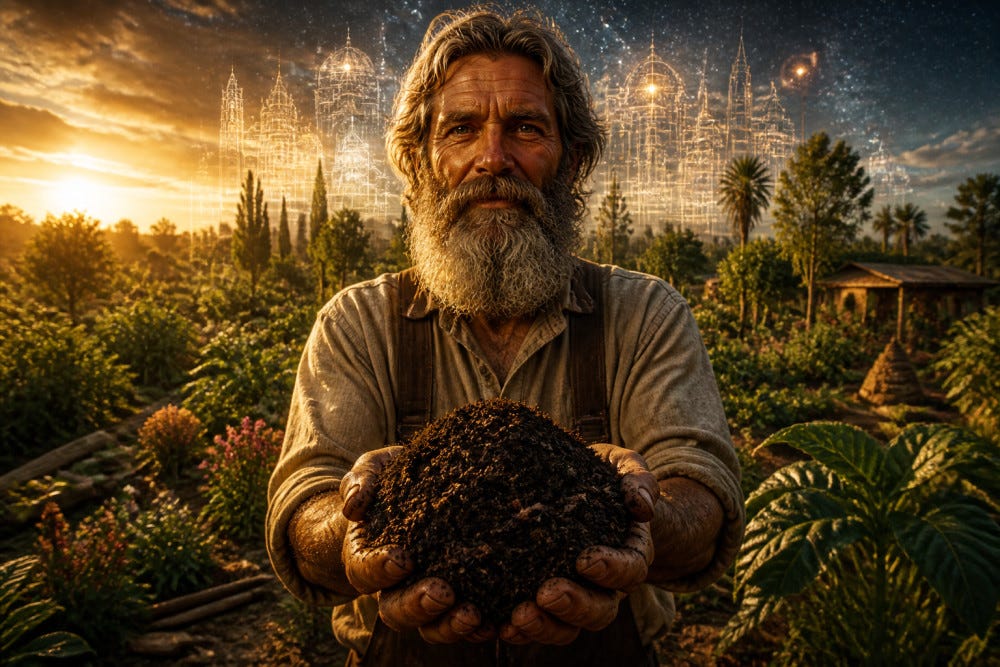
Stewardship, then, is not a moral obligation layered atop ownership—it is the mechanism of value creation. When you steward a resource, you align yourself with its true nature and purpose, which is Logos made manifest in action. The permaculture farmer demonstrates this with crystalline clarity. He does not impose chemicals, debt, and extraction upon the land; he cooperates with the soil’s own regenerative wisdom. The soil does not merely sustain his crops but improves year after year, requiring fewer external inputs precisely because he has achieved greater internal alignment. His wealth is measured not in yield extracted but in soil health accumulated, and his character is written permanently into the land he touches.
Stewardship also reveals the truth about ownership, and this truth is dangerous to the existing order. The legal fiction of ownership-without-stewardship is precisely what severs consequence from action. You can hold a title deed while destroying the land, or possess capital while using it to extract value from communities. But true ownership is demonstrated through stewardship, not certified by a document. What you genuinely own is what you cause to flourish. Everything else owns you—you are chained to the decay you set in motion.
This makes stewardship the great revealer of character, because it cannot be faked. Over time, what you steward either flourishes or decays, producing an objective, unfalsifiable record. Where fiat and crypto value is pure consensus detached from reality, stewardship value is causal—visible in the actual condition of what you touch. Reputation grounded in stewardship becomes the true currency: not an abstract token traded in speculation, but a verifiable history of Logos-aligned action made manifest in the world. And such an economy carries built-in constraints that fiat lacks, for these are not imposed regulations but the natural limits of reality itself. You cannot indefinitely extract from what you steward, nor accumulate beyond your capacity to tend it. True hierarchy emerges here not through force but as the natural fruit of demonstrated competence and character.
This reframes the strategic question entirely. The fiat system, like all external authority, depends upon our continued consent and our focused creative energy. The Frankl Strategy applies with full force: we may comply superficially with the apparatus—using its tokens to avoid needless persecution—while withdrawing our real creative focus and pouring it into building systems of genuine value. We become builders rather than negotiators. The negotiator argues within the existing rules and thereby keeps them alive; the builder pours his focus into something so aligned with reality that the old system simply becomes obsolete. We do not overthrow fiat in a fight that would only feed it our energy; we starve it of the golden character it could never manufacture.
This, perhaps, illuminates why Christ taught that it is harder for a wealthy man to enter the kingdom of heaven than for a camel to pass through the eye of a needle. The wealthy man of the fiat system is trapped in a sunk-cost fallacy of cosmic proportions. He has invested so totally in the external apparatus that to turn inward would mean confronting the terrifying possibility that everything he built rests on a false premise. So he clings to his accumulation, defending his investment in the lie, refusing the very transformation that would make him genuinely wealthy. His refusal to look inward is the inverted refusal—the “I won’t” disguised as “I can’t.” And the deepest irony is that the kingdom he cannot enter was within him the entire time.
For “the kingdom of heaven is within you” is not merely a spiritual platitude—it is the economic principle stated in its purest form. And the imagery of that kingdom confirms it: a house of “many mansions,” its streets “paved with gold.” Read through this lens, the symbolism becomes precise rather than fantastical. The many mansions are the differentiated capacities of the fully integrated self—the diverse domains of mastery that a transformed consciousness can steward. The streets paved with gold are not literal wealth but the very substance of that inner kingdom: gold so abundant it is walked upon, because in the internal economy, golden character is not hoarded in vaults but is the common Logocentric ground on which everything moves. The man who has done the mirror work—who has brought himself into coherence with the laws of identity, non-contradiction, and causality and disciplined his mind and emotions to utilize the eight intellectual standards—carries this inexhaustible wealth within him. He has located his treasure where neither moth nor rust corrupts, where no collapse of the consensus economy can touch it.
The conclusion is structural, written into the architecture of value itself: a just economy cannot be run by unjust men, and no perfect currency—fiat, gold, or crypto—can redeem a system built on false premises. The transformation must occur internally first; only then can the external follow naturally. We do not need a better token before we can build a better economy; we need to cultivate golden actors and allow the natural hierarchies of demonstrated stewardship to emerge among them. The medium of exchange becomes secondary, because the real backing was never the medium at all—it was always the character of the men who hold it. This is the translation of Logocentric individualism into economic philosophy: just as the sovereign individual exercises internal power that no external authority can compel, the golden steward generates value that no fiat fiction can counterfeit. Transform the lead within into gold, and you discover that you were always the standard the whole system was searching for.
The Stewardship Party embodies the practical expression of Logocentric economics at the institutional level, translating the principle of golden consciousness into concrete governance, where leaders measure themselves by how soon their office becomes unnecessary and every institution—from schoolyards to prisons to hospitals—operates as a place of regeneration rather than extraction. Their vision of a “Garden of Eden, Everywhere” is not mystical fantasy but the natural fruit of applying stewardship principles to the structures that govern our lives: food forests replacing lawns, dignity replacing desperation, and communities reconnected to the soil and to one another. Visit stewardshipparty.org to explore how stewardship transforms not just personal character and economics, but the very institutions through which we organize society.
Did you enjoy the article? Show your appreciation and buy me a coffee:
Bitcoin: bc1qmevs7evjxx2f3asapytt8jv8vt0et5q0tkct32
Doge: DBLkU7R4fd9VsMKimi7X8EtMnDJPUdnWrZ
XRP: r4pwVyTu2UwpcM7ZXavt98AgFXRLre52aj
POL: 0xEf62e7C4Eaf72504de70f28CDf43D1b382c8263F
THE UNITY PROCESS: I’ve created an integrative methodology called the Unity Process, which combines the philosophy of Natural Law, the Trivium Method, Socratic Questioning, Jungian shadow work, and Meridian Tapping—into an easy to use system that allows people to process their emotional upsets, work through trauma, correct poor thinking, discover meaning, set healthy boundaries, refine their viewpoints, and to achieve a positive focus. Read my philosophical treatise, “The Logocentric Christian,” to learn more about how Greek philosophy, the law of causality, the law of identity, the law of non-contradiction, the law of reason, and Jesus of Nazareth all connect together, and my political treatise, “Logocentric Individualism,” for a comprehensive political philosophy based in the Logos.