
The Sovereign’s Triquetra: Grounding Your Being in the Logos Across Identity, Causality, and Non-Contradiction
Three choices separate the sovereign from the slave.
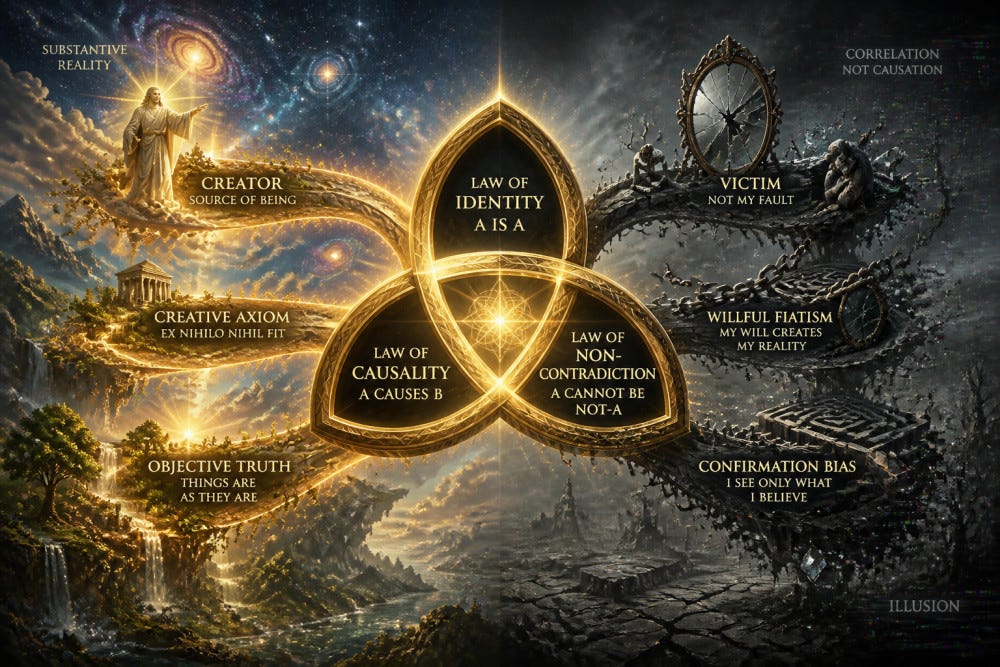
At the deepest level of human ontology, “Identity” with a capital “I” is not merely a social label or psychological construct, but the fundamental sum of identity, causality, and non-contradiction. This triad forms the architecture of the self, dictating whether one operates as the true, sovereign ego grounded in base reality, or as a false, survival-ego trapped in a parasitic simulation. The relative first cause of our psychological and spiritual trajectory is the core choice of premises we adopt across these three universal laws. Every individual faces a fundamental binary at the deepest levels of their being: to build upon a Logocentric foundation that generates substantive, reciprocal reality, or to succumb to a fiatist foundation that relies on extraction, decay, and the hijacking of true causal agency.
The first core binary choice manifests within the law of identity, presenting the dichotomy between the Drama Triangle’s victim and the TED Triangle’s creator. To choose the victim premise is to fuse one’s identity with pain and trauma, adopting a paralogistic ontology where the self is defined entirely by what happens to it. In this state, any objective truth becomes an existential threat, as challenging the narrative feels identical to annihilating the self. Conversely, the creator premise grounds identity in the Logos, viewing pain not as an identity marker, but as objective data. The creator maintains a sovereign distance from their suffering, allowing them to perceive the world through a lens of agency and objectivity rather than fragility and victimization.
The second core choice governs the law of causality, forcing a decision between the creative axiom (“I can”) and the axiom of willful fiatism (“I will” / “I won’t”). The creative axiom operates on the higher ontological plane of true “cause and effect,” serving as the internal engine that generates substantive reality through reciprocal action and responsibility. In stark contrast, the axiom of willful fiatism inverts the maxim that correlation does not imply causation, deliberately mistaking “correlation and effect” for true causality. This fiatist premise possesses no internal generative engine; it is inherently parasitic, surviving solely by reacting to external stimuli, demanding outcomes through sheer willful entitlement, and hijacking the causal agency of those operating on the higher plane to manifest effects for them (mirroring the modus operandi of the cuckoo bumblebee).
The third and final binary choice occurs within the law of non-contradiction, representing the battle between objective coherence (based upon truth) and fiat belief (egoic preservation). When grounded in the Logos, the premise of objective coherence demands that when a belief contradicts observable reality, the belief must be discarded and the model of reality updated. This requires the intellectual humility of the true self. However, the fiatist premise of egoic preservation inverts this law, decreeing that the core belief system cannot contain contradictions, and therefore any contradictory evidence must be rejected, distorted, or rationalized away—arrogance. Here, reason is hijacked not to discover truth, but to defend a predetermined conclusion, replacing the pursuit of coherent reality with the protection of one’s willfully held beliefs.
When the individual chooses these fiatist premises, it fundamentally downgrades its cognitive operating system, birthing specific cognitive biases that act as defense mechanisms for the false self. For the law of identity, the fusion of pain and the victim premise manifests most potently as hostile attribution bias. Because the victim’s pain-identity perceives all challenging truths as existential threats, the mind becomes hyper-vigilant, automatically interpreting ambiguous actions, neutral feedback, or objective observations from others as malicious attacks. This bias ensures the victim remains perpetually defensive and isolated, misperceiving the world to protect the fragile, trauma-bound ego from the perceived danger of growth or accountability.
This cognitive degradation continues through the other two laws, locking the false self into a reactive loop. For the law of causality, the axiom of willful fiatism breeds illusory correlation, where the mind perceives causal relationships between unrelated events simply because they occur together and serve the ego’s narrative. This allows the survival-ego to externalize blame and invent convenient stories without doing the rigorous work of tracing true causal mechanisms. Finally, for the law of non-contradiction, the fiat belief premise manifests as confirmation bias, a “faux” law of non-contradiction. The mind aggressively hunts for data that validates its predetermined beliefs while actively filtering out contradictory evidence, creating a closed, paralogistic loop where the ego feels coherent only because it has deliberately blinded itself to reality; this is what drives the unearned certainty found in the Dunning-Kruger Effect.
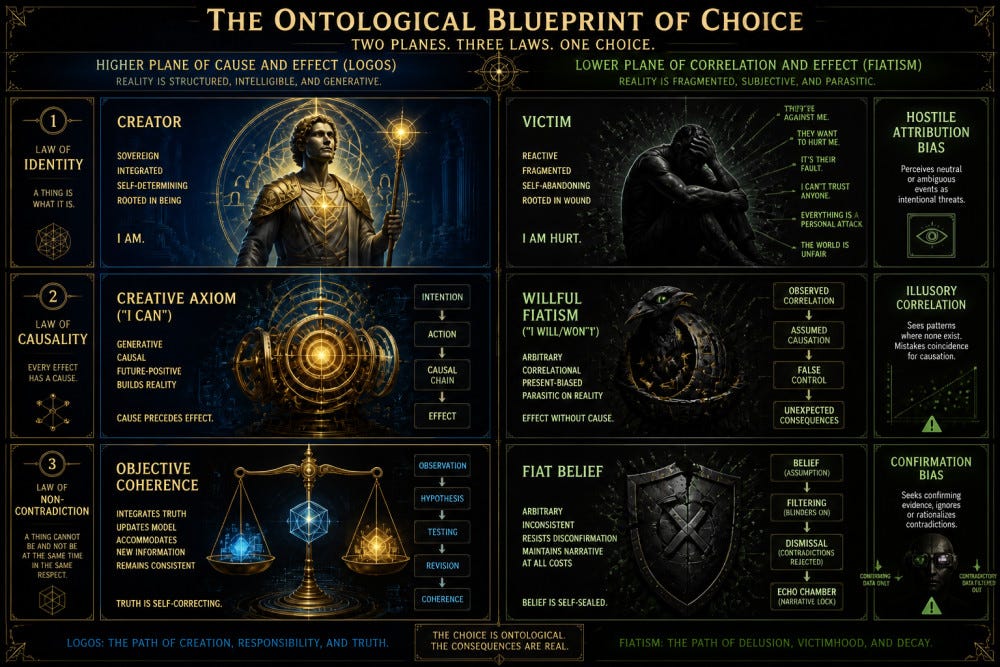
Ultimately, the telos of human development requires recognizing and rejecting these fiatist traps to reclaim our Logocentric foundation. By consciously choosing the creator identity over the victim identity, the creative axiom over the axiom of willful fiatism, and objective coherence over fiat beliefs, we dismantle the cognitive biases that keep us imprisoned in the lower plane of correlation and effect. This triad of choices restores the true self, transforming the individual into a relative first cause who projects their ontological weight into the world. In embracing the Logos, we abandon the parasitic survival-ego and step fully into our sovereignty, generating a substantive, reciprocal reality grounded in the highest truths of identity, causality, and non-contradiction.
Questions to reflect on:
When you face a painful setback, do you let it become your defining identity, or do you step back and view it as objective data for your growth?
When pursuing a difficult goal, are you actively generating the causes to achieve it, or are you simply expecting the outcome to happen because you demand it?
What is a deeply held belief you have about yourself or the world that you might be ignoring contradictory evidence for, just to protect your ego?
When receiving unexpected criticism, do you instinctively view it as a malicious attack on your character, or can you pause to hear the objective truth within it?
Looking at your daily habits and reactions, are you operating as the sovereign creator of your own reality, or are you reacting like a victim to things outside your control?
Did you enjoy the article? Show your appreciation and buy me a coffee:
Bitcoin: bc1qmevs7evjxx2f3asapytt8jv8vt0et5q0tkct32
Doge: DBLkU7R4fd9VsMKimi7X8EtMnDJPUdnWrZ
XRP: r4pwVyTu2UwpcM7ZXavt98AgFXRLre52aj
POL: 0xEf62e7C4Eaf72504de70f28CDf43D1b382c8263F
THE UNITY PROCESS: I’ve created an integrative methodology called the Unity Process, which combines the philosophy of Natural Law, the Trivium Method, Socratic Questioning, Jungian shadow work, and Meridian Tapping—into an easy to use system that allows people to process their emotional upsets, work through trauma, correct poor thinking, discover meaning, set healthy boundaries, refine their viewpoints, and to achieve a positive focus. Read my philosophical treatise, “The Logocentric Christian,” to learn more about how Greek philosophy, the law of causality, the law of identity, the law of non-contradiction, the law of reason, and Jesus of Nazareth all connect together, my political treatise, “Logocentric Individualism,” for a comprehensive political philosophy based in the Logos, and my philosophic treatise Logocentric Stewardship articulating my call to return to causal alignment with base reality.